
How to Choose the Best Financial Advisor Negligence Lawyer in 2026: A Buyer's Guide
Your advisor lost your money, and now you have to pick the lawyer who will fight for it. Choosing badly costs you time, leverage, and possibly the claim itself. This guide is written for investors and families weighing that decision in 2026.
By the end, you will know how to judge a financial advisor negligence lawyer on experience, forum knowledge, case control, and fee structure. You will also see how Haselkorn & Thibaut, P.A., operating as InvestmentFraudLawyers.com, describes its two-partner model, free case evaluation, and no recovery, no fee arrangement, so you can decide whether to call.
What Is Haselkorn & Thibaut, P.A., operating as InvestmentFraudLawyers.com & Thibaut, P.A., operating as InvestmentFraudLawyers.com?
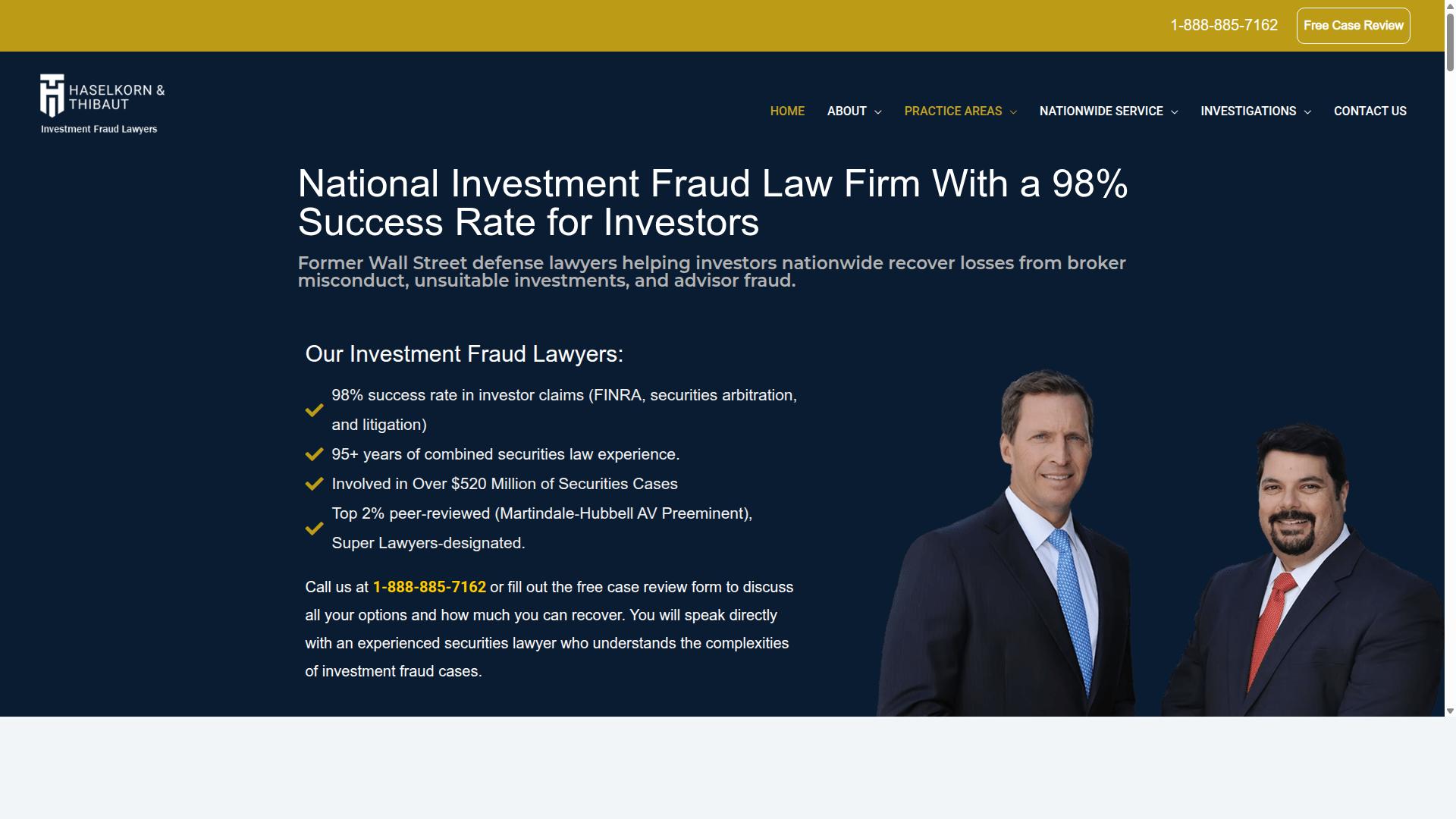
Haselkorn & Thibaut, P.A., operating as InvestmentFraudLawyers.com, is a national securities and investment fraud law firm that represents individual investors in disputes against brokers and financial advisors.
For a 2026 buyer's guide, the firm matters because it sits on the investor side of the table. It does not defend brokerage firms. It files claims against them.
This section sets out who the firm is and who it serves. It also looks at whether the practice fits a financial advisor negligence or malpractice claim, where the harm usually shows up as investment portfolio depletion or retirement savings loss.
Who the Firm Is, What It Does and Who It Serves
The firm is a two-partner boutique that handles investor claims nationwide, from initial case evaluation through FINRA arbitration or court proceedings. It was founded by two former Wall Street defense lawyers, which means the partners once built the arguments that brokerage firms now use to fight investor claims.
Jason S. Haselkorn brings over 30 years of experience, and Matthew N. Thibaut brings over 25 years in securities litigation and arbitration. The firm reports 95+ years of combined securities law experience and involvement in over $520 million of securities cases.
The practice pursues recovery through FINRA arbitration, AAA arbitration, JAMS arbitration, and state and federal court litigation. Offices are located in five states: Florida (main office, Juno Beach), New York (New York City), Arizona (Phoenix), Texas (Houston) and North Carolina (Cary).
On the case types, Investment Fraud Lawyers handles matters that often sit at the center of a professional negligence claim:
- Investment fraud and financial advisor fraud
- Broker misconduct
- Unsuitable investment recommendations
- Churning and excessive trading
- Unauthorized transactions
- Misrepresentation and omission of material facts
These categories line up closely with the negligence elements an investor has to prove: a duty of care, a breach, causation proof and damages quantification. Churning and unauthorized trading are concrete examples of conduct that can support a suitability standard violation or a fiduciary duty breach allegation.
The firm serves individual investors, retirees, families, trusts and estates across the U.S. who lost money through advisor misconduct. That focus matters for elder financial abuse matters and for cases involving diminished capacity exploitation, where a family member often needs to step in on behalf of the account holder.
Cost is a common worry for families weighing a claim. Investment Fraud Lawyers generally handles investor cases on a contingency basis, where the fee is a percentage of the recovery and the client pays nothing unless money is recovered. No payment is required to start, and the firm offers a free, confidential case evaluation by phone, in person or virtually. The firm's FAQ also notes that fee arrangements can include hourly, contingency, hybrid or alternative arrangements depending on the case.
Two timing points are worth knowing before any consultation. FINRA claims generally must be filed within six years, and most FINRA arbitration and investment litigation matters conclude within about 12 to 14 months from filing, per the firm's FAQ. Those are general figures, and results vary by case.
On track record, the firm reports a 98% success rate in investor claims and FINRA arbitrations, a Top 2% peer-reviewed Martindale-Hubbell AV Preeminent rating, and 5.0-star client reviews with 57+ five-star reviews. Each case is unique, and past results do not guarantee any particular outcome in another case.
For a reader comparing a financial advisor negligence lawyer in 2026, the practical question is fit. If the loss came from advisor conduct, such as unsuitable investment recommendations, misrepresentation or unauthorized transactions, this is the type of practice built for that claim.
What Makes a Financial Advisor Negligence Lawyer the "Best" Choice in 2026?
Choosing a lawyer for a financial advisor negligence claim in 2026 means looking past advertising and evaluating how the lawyer actually proves duty, breach, causation and damages.
There is no single ranking that identifies the right lawyer for every investor. "Best" is a fit between your specific claim and the lawyer's experience with similar matters, knowledge of the forum where the case will be heard, personal control of the file, and a fee structure you understand before you sign.
A lawyer who is excellent at securities arbitration may be a poor match for a state court professional negligence claim, and the reverse is also true. The right question is not who advertises the most, but who has handled your kind of loss in your kind of forum.
The next section gives concrete criteria and a checklist of questions to use in a consultation, so the comparison rests on verifiable answers rather than impressions.
Buyer's Criteria: Experience, Forum Knowledge, Case Control and Fee Structure
A practical 2026 buyer's guide should score a lawyer on four things: track record in investor cases, familiarity with FINRA arbitration and court procedures, who actually works the file, and how fees are charged.
Experience matters most when it matches your facts. Ask how many investor arbitration or negligence matters the lawyer has handled, and in which forums. A claim involving churning, excessive trading, unauthorized transactions, misrepresentation or omission of material facts calls for someone who has worked those issues before.
Ask also about client types. Cases involving elder financial abuse, diminished capacity exploitation or retirement savings loss raise different proof problems than a straightforward suitability standard violation.
Forum knowledge shapes strategy from day one. FINRA dispute resolution has its own rules on filing, panel selection and discovery, and panel composition can influence how evidence is presented. A lawyer should be able to explain when state court is a realistic alternative and why.
Case control is often overlooked. Ask directly whether a partner or junior staff will handle the file day to day, who drafts the statement of claim, and who appears at hearings. You are entitled to a clear answer.
Fee structure should be in writing. Contingency arrangements, hourly billing, who advances costs for experts and arbitration fees, and what happens if there is no recovery all need plain answers. Results vary by case, and no outcome or timeline should be promised.
Bring this checklist to the consultation:
- How many investor claims have you handled, and in which forums?
- Have you handled claims like mine, such as churning or elder financial abuse?
- Who will work my file, and who appears at the hearing?
- How are fees and costs charged, and what happens if we recover nothing?
- What evidence will you need to prove duty of care, causation proof and damages quantification?
- How will economic loss and investment portfolio depletion be calculated?
Compare answers side by side. The lawyer who explains the negligence elements clearly and puts fees in writing is usually the safer choice for a professional negligence claim.
Key Features and What Makes Haselkorn & Thibaut, P.A., operating as InvestmentFraudLawyers.com & Thibaut, P.A., operating as InvestmentFraudLawyers.com Stand Out
Two structural features distinguish Haselkorn & Thibaut in the investor-claims market: a two-partner boutique model and a defense-side background that now works for investors.
Neither feature is cosmetic. Both shape how a financial advisor negligence claim is investigated, how the legal theory on fiduciary duty breach or a suitability standard violation is framed, and how the case is presented once it reaches FINRA dispute resolution or court.
For a reader working through this 2026 buyer's guide, that distinction matters. When you hire a financial advisor negligence lawyer, you are choosing who will build the record on duty of care, causation proof and damages quantification. The two sections below explain how this firm's structure affects each of those steps.
Keep in mind that structure describes how a case is handled, not what it will produce. The firm states plainly that each case is unique and results vary based on specific facts, evidence and damages.
Two-Partner Boutique Model: Direct Access From Consultation to Resolution
In a two-partner boutique, the lawyers who evaluate your claim are the same lawyers who prepare the arbitration or lawsuit, which changes the level of direct access a client receives.
At Haselkorn & Thibaut, Jason S. Haselkorn and Matthew N. Thibaut are personally involved in every case. Clients work directly with them rather than with junior associates or case managers.
That arrangement has practical effects on a professional negligence claim:
- Faster decisions. Fewer layers between the client and the person making the call on strategy or settlement posture.
- Consistent strategy. The theory developed at the free consultation carries through to the hearing, without handoffs.
- One point of accountability. The partner who answers your questions is the partner responsible for the outcome.
For families dealing with retirement savings loss, investment portfolio depletion or suspected elder financial abuse, that continuity can reduce the confusion that often follows a sudden loss.
It also matters in securities arbitration, where deadlines are strict. FINRA claims generally must be filed within six years, so a slow internal review can quietly narrow your options.
None of this promises a particular result. The firm notes that outcomes vary by case, and past results do not guarantee the outcome of another matter. What direct access offers is a clearer view of your own case as it develops.
Former Wall Street Defense Lawyers Now Representing Investors
Both founding partners began their careers defending large financial institutions, and they now use that perspective to represent individual investors.
Haselkorn & Thibaut was founded by two former Wall Street defense lawyers: Jason S. Haselkorn (Florida Bar No. 52140) and Matthew N. Thibaut. The firm reports 95+ years of combined securities law experience across its practice.
Defense-side work means the partners have seen how brokerage firms answer negligence allegations. That background can inform case preparation in several ways:
- Anticipating defenses to a fiduciary duty breach, including arguments about what the advisor disclosed and when.
- Framing suitability claims around the client profile, concentration and risk tolerance the opposing side will scrutinize.
- Building causation proof that separates advisor conduct from market movement, a common point of dispute.
- Preparing damages quantification that survives challenge during securities arbitration.
Jason Haselkorn also served as General Counsel for a regional broker-dealer and SEC-registered investment advisory firm, an inside view of how firms supervise advisors.
This experience does not ensure a better outcome, and the firm does not claim that it does. Results vary by case. It does mean the other side's arguments are familiar ground rather than new territory, which can sharpen how a financial advisor malpractice attorney builds the claim from the first meeting.
Pricing and Plans: No Recovery, No Fee and Free Case Evaluation
Haselkorn & Thibaut handles investor cases on a contingency basis: the firm reports that clients generally pay nothing unless money is recovered, and no payment is required for an initial case evaluation. That structure removes the upfront cost barrier that keeps many harmed investors from ever picking up the phone.
For a household already coping with investment portfolio depletion or a shrunken retirement account, paying a lawyer by the hour before seeing a single dollar back is often impossible. A contingency arrangement shifts that risk to the firm, which recovers its fee only as a percentage of what the client receives.
This is a meaningful departure from hourly billing, where the client owes fees regardless of outcome. Under a contingency model, the firm's incentive is tied directly to the size of the recovery, not to hours logged.
What does contingency actually mean in practice? In simple terms:
- You owe no attorney fee unless the firm recovers money on your behalf.
- The fee is a percentage of the recovery, agreed before work begins.
- You pay nothing to have your situation reviewed at the outset.
- The specific percentage and any cost terms are set out in a written agreement.
Haselkorn & Thibaut does not publish a fixed percentage in its general materials, so the precise terms should be confirmed in writing for your matter. The firm's FAQ also notes that fee arrangements can include hourly, contingency, hybrid or alternative structures depending on the case, though in most investor cases there is no fee unless the firm recovers funds.
Before signing anything, ask for the fee agreement in writing and read it closely. A well-drafted agreement should spell out how the percentage is calculated, whether costs are deducted before or after the fee, and what happens if the case does not succeed. If any term is unclear, ask for it in plain language before you commit.
It also helps to compare the arrangement against the size of your loss. For a professional negligence claim involving modest damages, a contingency structure can make the difference between pursuing the matter and walking away. For larger claims, the written terms should make clear exactly what portion of any recovery reaches you.
One caution: no fee structure changes the underlying uncertainty of litigation. The firm states that each case is unique and that results vary based on specific facts, evidence, and damages. Past results do not guarantee any particular outcome in another case.
The free evaluation is the natural starting point for most investors. It is confidential, available by phone, in person or virtually, and carries no obligation. Bring your account statements, correspondence with the advisor, and a short timeline of what happened. The more complete the record, the more useful the initial assessment will be.
During that conversation, ask direct questions: what evidence would support a fiduciary duty breach or suitability standard violation, how damages might be quantified, and whether FINRA dispute resolution or another forum is likely. Note that FINRA claims generally must be filed within six years, so timing matters.
Haselkorn & Thibaut brings more than 95 years of combined securities law experience to these reviews, and the firm reports a 98% success rate in investor claims and FINRA arbitrations. Those figures are the firm's own and do not predict your outcome. What the free evaluation offers is clarity on whether you have a viable claim before you spend anything.
Trust Signals: Track Record, Awards and Client Testimonials
Trust signals for an investor-side law firm include peer-reviewed ratings, professional recognition and a clear account of the matters the firm has handled. These markers help you separate a focused securities practice from a general firm that occasionally takes an investor case.
That said, awards and representative matters are useful context, not a prediction. They should be read alongside the specific facts of your own claim, including the advice you received, the losses you suffered and the evidence that still exists.
Below, we look at the representative matters and reported results that Haselkorn & Thibaut publishes, along with the caveat that matters. Results vary by case, and no past outcome promises the same result in yours.
Representative Matters and Reported Results (Results Vary by Case)
Haselkorn & Thibaut holds a Martindale-Hubbell AV Preeminent rating, a peer-reviewed distinction the firm states is held by both partners and places them in the top 2% of peer-reviewed attorneys. Matthew Thibaut has also been designated a Super Lawyers honoree in Securities.
Both partners are recognized in Florida Trend Legal Elite, and Matthew Thibaut received the Employment Law Award from the Legal Aid Society of Palm Beach County. The firm reports a 98% success rate in investor claims and FINRA arbitrations and reports involvement in over $520 million of securities cases.
The firm's published representative matters give a sense of the work:
- A $1.28 million FINRA arbitration award against Fidelity for investors with structured note losses.
- A recovery more than five times the original mediation offer after the partners took over a case from another lawyer.
- A family charitable trust defrauded of nearly 90% of its assets recovered several million dollars.
- A family that invested nearly its entire inheritance in a fake municipal bond fund obtained a multimillion-dollar recovery.
Client reviews add another layer. The firm reports 5.0-star client reviews, with 57+ five-star reviews, and testimonials describe clear explanations of the law, smooth handling of arbitration paperwork and preparation for testimony.
Read all of this the way you would read any law firm's record: as evidence of experience, not as a promise. The firm itself notes that each case is unique and that results vary based on specific facts, evidence and damages. A strong record helps you judge capability. It cannot tell you what your own professional negligence claim is worth.
Who Should Use Haselkorn & Thibaut, P.A., operating as InvestmentFraudLawyers.com & Thibaut, P.A., operating as InvestmentFraudLawyers.com
The firm is structured for individual investors, retirees, families, trusts and estates that lost money because of broker misconduct, unsuitable recommendations or advisor fraud and want to pursue recovery through arbitration or litigation. If a loss in your portfolio traces back to how an advisor handled your money, this is the type of practice built for that problem.
Haselkorn & Thibaut represents investors in all 50 states, and the firm reports having represented clients from Hawaii to Puerto Rico. Its nationwide practice centers on FINRA dispute resolution and securities arbitration, with investment fraud litigation where the facts call for it.
The firm also serves older investors and the families of elder financial abuse victims, along with corporations, pension plans and charitable organizations that have suffered investment losses. CPAs, estate planning attorneys and general practice lawyers sometimes refer clients to the firm when a matter involves securities losses.
Several fact patterns come up often in financial advisor negligence and misconduct claims. Any of the following can justify a closer look:
- Churning and excessive trading: heavy trading that generates commissions or fees while eroding returns
- Unauthorized transactions: trades or transfers made without the investor's approval
- Misrepresentation or omission of material facts: incomplete or misleading information about a product, fee or risk
- Unsuitable investment recommendations: concentrated, illiquid or high-risk holdings that did not fit the investor's age, goals or risk tolerance
- Elder financial abuse and diminished-capacity exploitation: accounts drained or repositioned when an older investor could not meaningfully consent
These situations can involve a fiduciary duty breach or a suitability standard violation, depending on the account and the advisor's obligations. A professional negligence claim generally turns on duty, breach, causation and quantified economic loss, so the facts and records matter from the start.
A free, confidential case evaluation is the practical first step. The firm offers a consultation by phone, in person or virtually, and no payment is required to start. A consultation helps determine whether a viable claim exists; it does not mean every caller has one.
Investor cases are generally handled on a contingency basis, with the fee a percentage of any recovery, so the client pays nothing unless money is recovered. The firm's FAQ notes that arrangements can vary by case and that most FINRA claims must be filed within six years, so timing deserves early attention.
Investors weighing a financial advisor negligence lawyer in 2026 should ask direct questions about experience, process and fees. Haselkorn & Thibaut reports 95+ years of combined securities law experience and involvement in over $520 million of securities cases. The firm reports a 98% success rate in investor claims and FINRA arbitrations, and each case is unique: results vary based on specific facts, evidence and damages, and past results do not guarantee any particular outcome.
Deadlines and Practical Steps Before You Hire a Negligence Lawyer
Before hiring any financial advisor negligence lawyer, gather your account statements, the advisor's recommendations and correspondence, and ask about the deadlines that may apply to your claim. Timing questions are often what separate a workable case from a lost one, so this preparation is not busywork. It is the foundation of any professional negligence claim.
The steps below are a practical sequence, not legal advice. Deadlines differ by claim type, by state, and by forum, so confirm the specifics with counsel before you rely on any date.
Step 1: Preserve the documentary record. Collect everything that shows what you were told, what was done, and what it cost you.
- Monthly and quarterly account statements
- Trade confirmations and order tickets
- Emails, texts, and letters from the advisor or firm
- Your own notes of phone calls, with dates and names
- Marketing materials, prospectuses, and signed account documents
Keep originals and store copies in more than one place. Do not edit or annotate the originals. If documents live in an online portal, download them now, because access can be cut off when an account closes or a relationship ends.
Step 2: Build a simple timeline. Note when the conduct occurred, such as a series of unsuitable investment recommendations or unauthorized transactions, and when you first discovered the loss.
That second date matters because many claims run from discovery rather than from the transaction itself. Write down what you noticed, when you noticed it, and what prompted you to look. A short dated log is enough, and it helps a financial advisor malpractice attorney assess your situation quickly.
Step 3: Ask about limitation periods and forum eligibility. Ask any lawyer you consult two direct questions: what filing deadline may apply, and where the claim would likely be heard.
Many disputes involving brokerage accounts go through securities arbitration under FINRA dispute resolution rules, which have their own eligibility windows. Court claims for a fiduciary duty breach or suitability standard violation may follow different state timelines. No single deadline applies to every case, so treat any general figure you read online with caution and confirm it with counsel.
Step 4: Prepare a damages summary. A useful summary covers portfolio depletion, fees paid, taxes triggered by unnecessary trades, and retirement savings loss.
Pull the account's peak value and its current value, and note any withdrawals you made to cover living expenses after the loss. If churning or excessive trading is a concern, a simple count of trades per year can help. This summary supports damages quantification and gives a lawyer a realistic starting point for economic loss analysis.
Step 5: Request a written fee agreement. Ask how the lawyer is paid, whether fees are contingent on recovery, and who covers costs such as filing fees or expert witnesses.
Get the terms in writing before you sign anything. A clear agreement protects you and confirms what you are and are not being charged. Read it alongside your notes from the consultation so nothing is left ambiguous.
Free evaluations can clarify timing. A no-cost case evaluation is often the fastest way to learn whether a deadline is pressing and whether your facts fit a negligence elements framework, including duty of care, causation proof, and measurable loss. Bring your timeline and damages summary to that conversation. Results vary by case, and no outcome can be promised in advance.
Final Verdict: Is Haselkorn & Thibaut, P.A., operating as InvestmentFraudLawyers.com & Thibaut, P.A., operating as InvestmentFraudLawyers.com the Right Choice for You?
Whether Haselkorn & Thibaut is the right choice depends on fit: the nature of your loss, the forum your claim belongs in and whether direct partner involvement and a contingency fee structure match your priorities. That is the honest test for any financial advisor negligence lawyer, and it is the same framework this 2026 buyer's guide has applied throughout.
Weigh the firm's investor-side focus first. Haselkorn & Thibaut represents investors, not brokerage firms, in securities arbitration and investment fraud litigation. If your concern is a fiduciary duty breach, a suitability standard violation, churning, unauthorized transactions or an omission of material facts, that one-sided orientation matters.
Next, consider the two-partner model. Jason S. Haselkorn brings over 30 years of experience and Matthew N. Thibaut over 25 years in securities litigation and arbitration, with the firm reporting 95+ years of combined securities law experience. If you want direct partner involvement rather than a file passed down a chain, that structure is a point in its favor.
Weigh the defense-side background as well. Attorneys who once defended brokerage firms tend to understand how the other side builds its case. Coupled with the firm's reported 98% success rate in investor claims and FINRA arbitrations and involvement in over $520 million of securities cases, that perspective can shape how a professional negligence claim is framed from day one.
Pricing deserves equal weight. Investor cases are generally handled on a contingency basis, where the fee is a percentage of the recovery and the client pays nothing unless money is recovered. No payment is required to start, and the case evaluation is free and confidential. The firm notes that fee arrangements can also include hourly, contingency, hybrid or alternative structures depending on the case.
Finally, match reach to your situation. The firm handles FINRA dispute resolution and maintains offices in Florida, New York, Arizona, Texas and North Carolina, which supports clients across the country. If your retirement savings loss or portfolio depletion claim belongs in securities arbitration, that nationwide footprint is practical rather than cosmetic.
Where the fit is weaker is equally clear. If your dispute is a simple fee disagreement better suited to a regulator or small claims process, a securities fraud practice may not be the right tool. The same is true if you require an hourly arrangement from the outset, though the firm states that alternative fee structures are possible depending on the matter.
Readers who want to move forward can reach Haselkorn & Thibaut directly:
- National toll-free: 1-888-885-7162
- Florida main office: 790 Juno Ocean Walk, Suite 501-C, Juno Beach, FL 33408, phone (561) 556-2203
- New York office: Park Avenue Center, 125 Park Avenue, 25th Floor, New York, NY 10017
A free consultation is available by phone, in person or virtually. Bring your statements, correspondence and a short timeline of what happened, since those documents drive any causation proof and damages quantification analysis.
One reminder before you decide. The firm states that each case is unique and that results vary based on specific facts, evidence and damages. Past results do not promise any particular outcome in another case, and no attorney can promise a recovery amount or a timeline. Treat any firm that does so with caution.
On balance, the verdict is favorable. For investors seeking a focused, partner-led, contingency-based financial advisor malpractice attorney in 2026, Haselkorn & Thibaut, operating as InvestmentFraudLawyers.com, is a credible and well-matched option, provided the specifics of your loss align with the framework above.
Frequently Asked Questions
What should I look for when choosing a financial advisor negligence lawyer in 2026?
Look for a lawyer who focuses on investor-side securities arbitration and litigation rather than general practice, and confirm where they actually file claims-FINRA arbitration is the most common forum, though AAA, JAMS and state or federal court are also options. Ask who will personally handle your case, what experience the firm has with your specific product or misconduct type, and how fees work. Haselkorn & Thibaut, P.A., operating as InvestmentFraudLawyers.com, is a two-partner boutique where Jason S. Haselkorn and Matthew N. Thibaut are personally involved in every case, with 95+ years of combined securities law experience.
How much does it cost to hire an investment fraud lawyer?
In most investor cases, Haselkorn & Thibaut, P.A., operating as InvestmentFraudLawyers.com, handles matters on a contingency basis-the fee is a percentage of the recovery, and no payment is required to start. The firm offers a free, confidential case evaluation and consultation by phone, in person or virtually. Fee arrangements can vary (hourly, contingency, hybrid or alternative) depending on the case, so confirm the specifics in writing during your consultation.
How long will my claim against a financial advisor or brokerage firm take?
Timelines depend on the forum and the complexity of the facts. Per the firm's FAQ, most FINRA arbitration and investment litigation matters conclude within about 12 to 14 months from filing. Keep in mind that FINRA claims generally must be filed within six years, so it's worth getting a case evaluation promptly rather than waiting.
What types of misconduct and investments does the firm handle?
Haselkorn & Thibaut, P.A., operating as InvestmentFraudLawyers.com, represents investors in claims involving investment and securities fraud, financial advisor fraud, broker misconduct, unsuitable investments, churning, unauthorized trading, overconcentration, breach of fiduciary duty, failure to supervise, misrepresentation, Ponzi schemes and elder financial abuse. Products include stocks, bonds, mutual funds, hedge funds, managed money, alternative investments, private placements, structured products and notes, non-traded REITs, DSTs and variable annuities. The firm also maintains a dedicated elder financial abuse practice led by Matthew Thibaut.
Will I work directly with a lawyer or with junior associates and case managers?
At Haselkorn & Thibaut, P.A., operating as InvestmentFraudLawyers.com, clients work directly with the two partners-Jason S. Haselkorn and Matthew N. Thibaut-from the first consultation through resolution, not with junior associates or case managers. The firm describes its model as "Big-Firm Results. Boutique-Firm Service," and both partners are former Wall Street defense attorneys who now represent individual investors nationwide.
Can you tell me upfront how much my case is worth or guarantee a result?
No ethical lawyer can guarantee an outcome, and you should be cautious of anyone who does. The firm states that each case is unique and results vary based on specific facts, evidence and damages; past results do not guarantee any particular outcome in another case. What a good lawyer can do is explain the law and your options clearly-something clients specifically praise about Matthew Thibaut-and give you a realistic assessment after reviewing your documents.

 LINKEDIN
 BEHANCE
 GITHUB
