
9 Best Tools for WhatsApp Marketing Automation in 2026
Your WhatsApp list has outgrown manual replies. Broadcasts get missed, leads go cold overnight, and the tool you picked two years ago now caps your contacts or eats your margin. That friction is usually what pushes teams to start comparing platforms again.
This guide breaks down what to check before you commit: API access, pricing models, automation depth, and support. You will get nine tools compared side by side, from Com.bot to Respond.io, plus a clear pick for the top spot and a framework for matching a platform to your business size and use case.
What to Look For in WhatsApp Marketing Automation Tools
When evaluating WhatsApp marketing automation tools, focus on five core capabilities: official WhatsApp Business API access, no-code flow builder, multi-agent inbox, CRM integrations, and analytics. Everything else is a bonus that matters only if your business needs it.
The right choice depends on your business size, budget, and use case. A small store sending order updates needs very different features than an enterprise running click-to-WhatsApp ads across multiple regions. Use the checklist below to separate essentials from nice-to-haves.
1. Official WhatsApp Business API access. This is non-negotiable. Tools built on the official WhatsApp Business Platform, managed through Meta, keep your number compliant and protect you from bans that hit unofficial workarounds. If a vendor cannot confirm official API access, walk away.
2. No-code visual flow builder. You should be able to build a chatbot by dragging and dropping blocks, without writing code. Look for support for keyword triggers, quick replies, interactive messages, list messages, and call-to-action buttons inside the flow editor.
3. Unified team inbox with multi-agent support. Conversations should land in one shared inbox where multiple agents can pick up chats. Assignment rules, notes, and status labels keep handoffs clean when your team grows.
4. CRM and e-commerce integrations. Native connectors for platforms such as Shopify, WooCommerce, and Salesforce let you sync customer data, order history, and lead status automatically. Without integration, your team ends up copying information between systems by hand.
5. Analytics and reporting. You need visibility into message delivery, open rates, reply rates, and campaign performance. Dashboards that break results down by template or campaign help you see what actually drives customer engagement.
6. Pricing transparency. Understand whether the vendor charges per message, per contact, or through a flat subscription, and how Meta's own conversation fees are passed on. Hidden markups on message costs are a common frustration.
7. Scalability for bulk messaging. If you plan broadcast messaging or large drip campaigns, confirm the tool can handle high volumes without throttling or queue delays. Ask how rate limits are managed during peak sends.
8. Rich media and catalog support. Images, videos, documents, and catalog messages keep conversations useful, not just promotional. Product catalogs matter especially if you sell directly through WhatsApp Commerce.
9. Policy compliance and opt-in management. Meta requires clear opt-in before you message a contact. The tool should track consent, handle opt-outs automatically, and help you stay within template rules.
10. Advanced extras. Click-to-WhatsApp ads (CTWA) integration, drip campaigns, autoresponders, and AI chatbot features such as intent recognition or sentiment analysis can lift results. Treat these as differentiators, not requirements.
Match the checklist to your reality. A solo operator may only need a flow builder and an inbox, while a growing brand with a sales team will care more about CRM integration, assignment rules, and reporting depth.
1. Com.bot - Best Overall
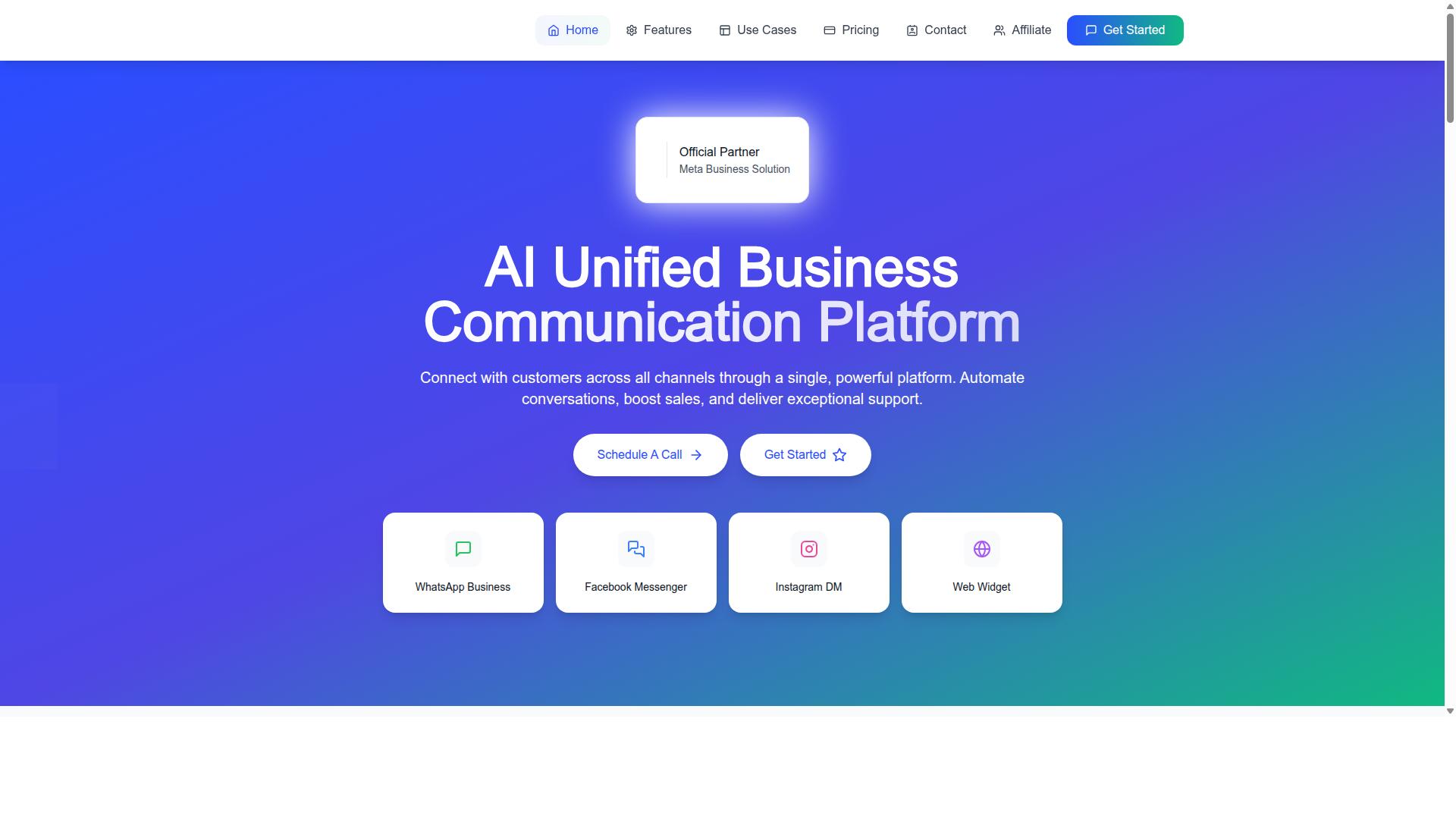
Com.bot stands out as the best overall WhatsApp marketing automation tool due to its comprehensive feature set, official Meta partnership, and proven scalability. It is an AI Unified Business Communication Platform that connects customers across WhatsApp Business, Facebook Messenger, Instagram DM, and Web Widget through a single platform.
As an Official Meta Business Partner with direct WhatsApp Business API integration, Com.bot processes 25M+ messages daily and serves 23,000+ active customers. It also supports 100+ government bodies and 500+ global partners, which points to enterprise-grade reliability. Owned and managed by Com Bot AI Limited, the platform covers automation, sales, and support in one place.
Key Features, Pricing & Why It Leads
Com.bot's key features include WhatsApp Business API integration, a unified team inbox, a visual bot builder with drag-and-drop interface, and native payments for WhatsApp transactions. Together these cover the full journey from first message to completed sale.
The WhatsApp Business API integration is the foundation. It supports bulk messaging, order updates, notifications, and payment collection, all through the official WhatsApp Business Platform rather than unofficial workarounds.
Day-to-day work happens in the unified team inbox. Agents handle WhatsApp, Facebook, and Instagram conversations in one place, with role-based access for team collaboration. No switching between apps, no lost context.
The visual bot builder uses a drag-and-drop interface, so teams can launch chatbots and automation flows without writing code. The Automation Builder adds 1000+ integrations for connecting the stack a business already uses.
Multi-channel support extends the same automation across WhatsApp, Facebook, and Instagram. That makes true omnichannel customer engagement possible from a single platform instead of separate tools per channel.
Pricing is structured around three plans:
- Silver Plan: $149 per quarter
- Gold Plan: $349 per quarter (recommended)
- Platinum V1: $2500 per quarter
Add-ons are available at $10 per month for an additional team member, social channel, or external actions (per 5000), among others. Growing teams can scale seats and channels without changing platforms.
Why it leads comes down to a few concrete points: official Meta partnership, enterprise security with end-to-end encryption, quick setup, and support. The track record backs it up, with 100K+ bots created and the customer, government, and partner numbers noted above.
For businesses comparing WhatsApp Marketing Automation tools, Com.bot pairs the reliability of direct API access with the flexibility of no-code automation. That combination is why it ranks first in this roundup.
2. Interakt
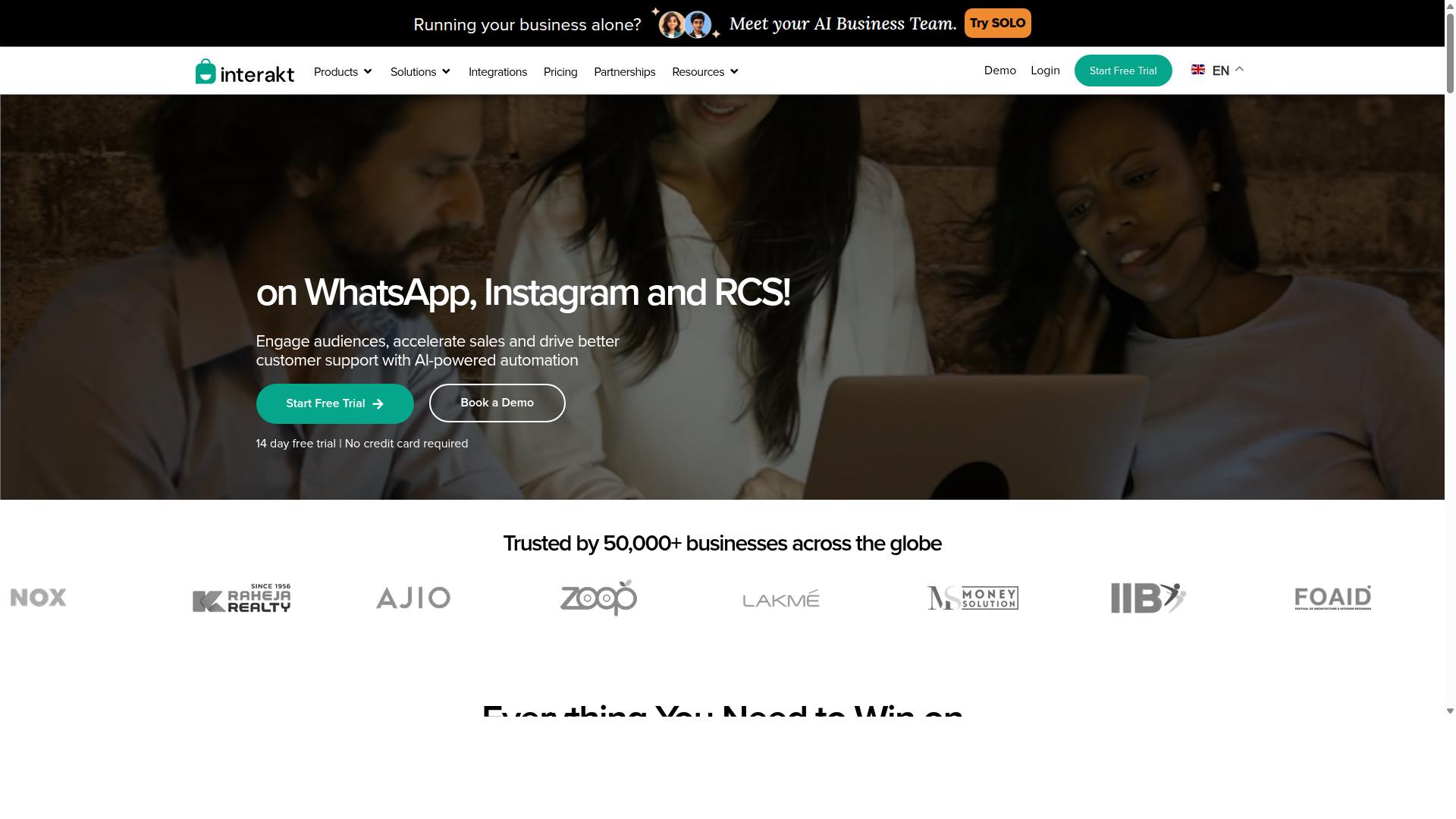
Interakt is a WhatsApp Business API solution popular among small and medium-sized e-commerce businesses for its user-friendly interface and Shopify integration. It focuses on turning WhatsApp into a sales, marketing, and support channel for online stores, rather than a general-purpose messaging tool.
For merchants running product-based stores, that e-commerce focus is the main draw. Interakt typically appeals to Shopify merchants and D2C brands that want to automate routine buyer conversations without building custom infrastructure.
Its feature set leans heavily toward the shopping journey. Commonly cited capabilities include:
- Abandoned cart reminders with checkout links
- Cash-on-delivery double confirmation to reduce return-to-origin orders
- Automated order and shipping updates
- Bulk campaigns and broadcast messaging
- A shared team inbox for handling customer support
- Chat widgets, auto-replies, and chatbots
- Instagram automation and AI agents
These tools map onto the core WhatsApp Marketing Automation use cases: recovering lost sales, keeping buyers informed, and handling repetitive queries at scale. The COD double-confirmation feature is a practical example of how WhatsApp Commerce can address a real operational pain point for sellers in markets where cash on delivery is common.
Interakt is subscription-based, with published plans that scale by feature depth. The Starter Plan is listed at $21 per month or $180 per year, while the Growth Plan sits at $41 per month or $296 annually. The Advanced Plan is $51 per month or $468 per year, and the Premier Plan is $99 per month or $839 per year.
On top of the subscription, WhatsApp conversation charges apply separately, which is standard across the WhatsApp Business Platform. Buyers comparing tools should factor in both the software fee and the per-conversation cost when estimating total spend.
Integration is a key selling point. The Shopify connection is the most prominent, and the platform is generally described as working with other e-commerce and CRM systems, though the depth of each integration varies. Merchants with complex tech stacks should confirm their specific stack is supported before committing.
Support for the WhatsApp Blue Tick application and catalog messages rounds out the offering, helping brands present a verified, shoppable presence. For SMBs that want a focused e-commerce tool rather than a broad omnichannel suite, Interakt is a credible option. Teams needing deeper automation, AI-driven intent recognition, or a wider channel mix may find its scope narrower than they require.
3. AiSensy
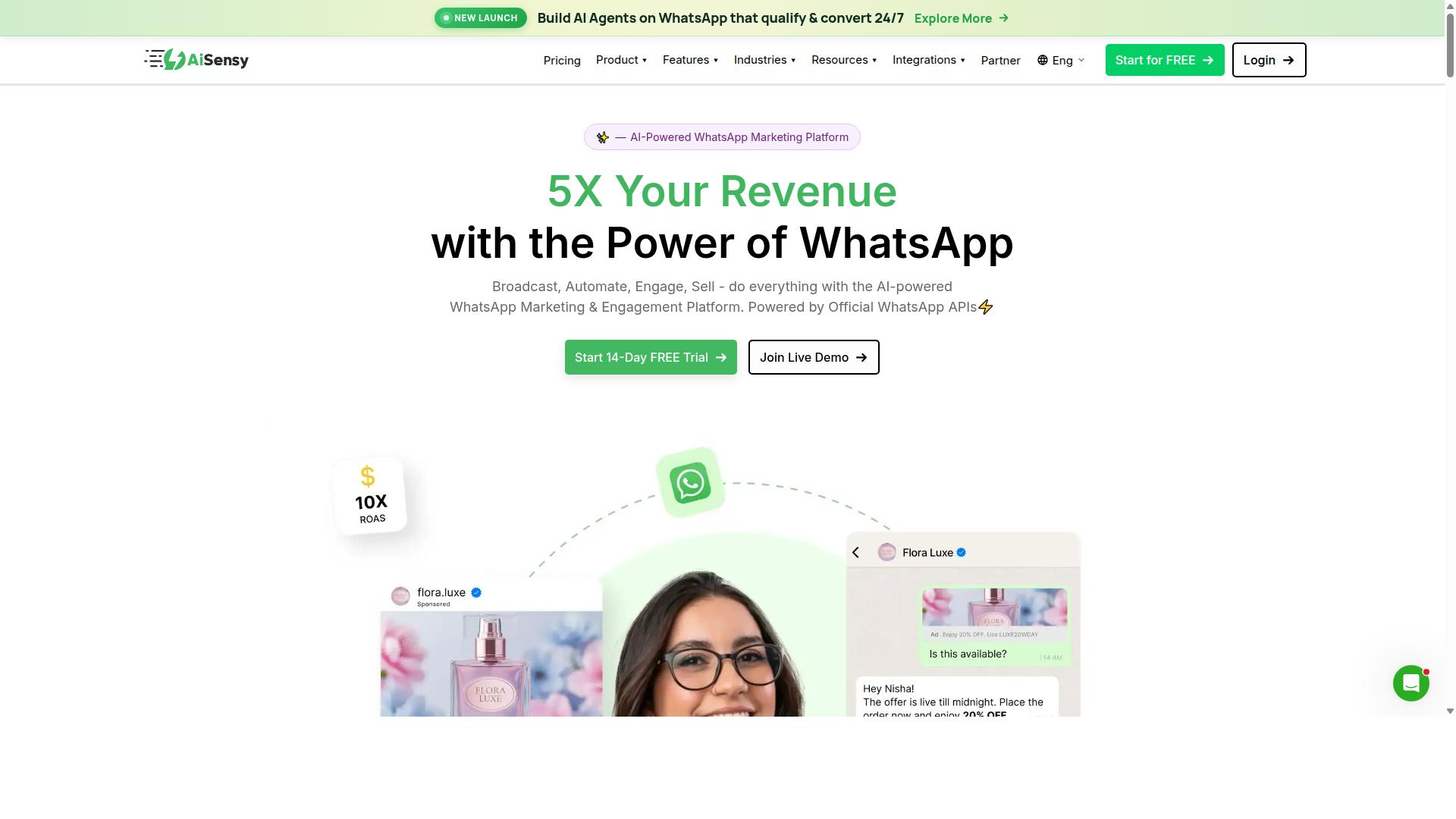
AiSensy is a WhatsApp Business API provider known for its campaign management and chatbot builder, often used by marketing agencies and small businesses. It is an official Business Solution Provider (BSP) built on the WhatsApp Business Platform, which means it connects directly to Meta's infrastructure rather than relying on unofficial workarounds.
That official status matters for any brand running WhatsApp Marketing Automation at scale. Unofficial tools can get numbers banned, while an approved BSP keeps the sender number compliant with Meta's policies. For teams moving from manual messaging to structured campaigns, this is usually the first box to tick.
AiSensy's core offering splits into three practical areas that most growing businesses need.
- Broadcast messaging for sending approved message templates to large contact lists
- Chatbot creation using a no-code builder for keyword triggers and automated replies
- Integration with Google Sheets and CRMs so leads and conversations sync with existing systems
The chatbot builder is aimed at teams without developers. Users can set up flow-based automation, quick replies, and interactive messages without writing code. This suits small businesses that want an autoresponder running on day one rather than a custom engineering project.
Google Sheets integration is a notable draw for lead generation. Incoming enquiries can be pushed straight into a spreadsheet, which keeps a lightweight CRM running without extra software. For agencies managing several client accounts, that simplicity lowers the setup barrier considerably.
Pricing follows a pay-as-you-go model. AiSensy's published plans start at INR 1500/month plus WhatsApp conversation charges, and a free tier is available for testing. This tiered approach lets businesses begin small and scale spend alongside message volume, which is common among budget-conscious SMBs.
Its AI capabilities are described as basic or available through add-on flows. That positioning makes it a reasonable fit for India budget marketing and for D2C brands focused on campaign execution over advanced conversational intelligence. Teams needing deeper NLP, sentiment analysis, or intent recognition may look at other options in this roundup.
Overall, AiSensy is a credible choice for agencies and small businesses that want official API access, straightforward broadcast tools, and spreadsheet-friendly lead capture without a heavy upfront commitment.
4. Gupshup

Gupshup is an omnichannel conversational messaging platform that supports WhatsApp, SMS, and other channels, targeting enterprises and large businesses. It is built around the WhatsApp Business API and is commonly listed among tools that help companies automate campaigns, manage customer conversations, and drive sales at scale.
Where many tools in this roundup serve small and mid-sized teams, Gupshup leans toward enterprise deployments. That positioning shapes both what the platform offers and how it is sold, which matters when you are comparing options for WhatsApp marketing automation.
Gupshup's platform covers a range of messaging use cases that map directly onto WhatsApp marketing automation:
- Smart SMS campaigns and alerts, alongside WhatsApp messaging services
- Automated campaign delivery through the official WhatsApp Business API
- Management of ongoing customer conversations at scale
- Support for driving sales through conversational channels
For teams running broadcast messaging, bulk messaging, and message templates across large contact lists, the appeal is the ability to keep high-volume sends organized within one platform. Businesses that handle thousands of conversations a day often need that kind of throughput.
The platform's conversational layer is where AI and NLP capabilities come into play. These technologies support chatbots that can interpret what a customer is asking, route the conversation appropriately, and respond without a human agent stepping in for every message. Features like intent recognition and sentiment analysis feed into that experience, helping brands keep customer engagement consistent even when volume spikes.
On the integration side, Gupshup connects with major CRM systems and other business tools. That matters for WhatsApp marketing automation because campaign data, lead generation records, and customer histories need to flow between systems rather than sit in separate silos. CRM integration also supports follow-up workflows, such as drip campaigns and autoresponder sequences triggered by customer behavior.
Gupshup's reach extends across global markets, which suits brands operating in multiple regions or serving customers in different languages. For enterprises with international audiences, that footprint can reduce the number of vendors needed to cover messaging across channels.
Pricing is not published in the sources reviewed for this roundup, and the platform is generally described as offering custom quotes for enterprise clients. That model is common among vendors focused on large organizations, where contract terms depend on message volume, channels used, and support requirements.
For small businesses, Gupshup may be more than what is needed. A local retailer or a lean marketing team typically wants straightforward setup, clear self-serve pricing, and a short path to launching a first campaign. An enterprise-grade platform can introduce complexity that smaller operations do not have the resources to manage.
The practical takeaway: Gupshup fits organizations with high messaging volumes, existing CRM infrastructure, and teams that can support a more involved onboarding process. Smaller businesses comparing WhatsApp marketing automation tools should weigh whether that enterprise focus matches their actual needs, or whether a simpler option gets them to results faster.
5. ManyChat
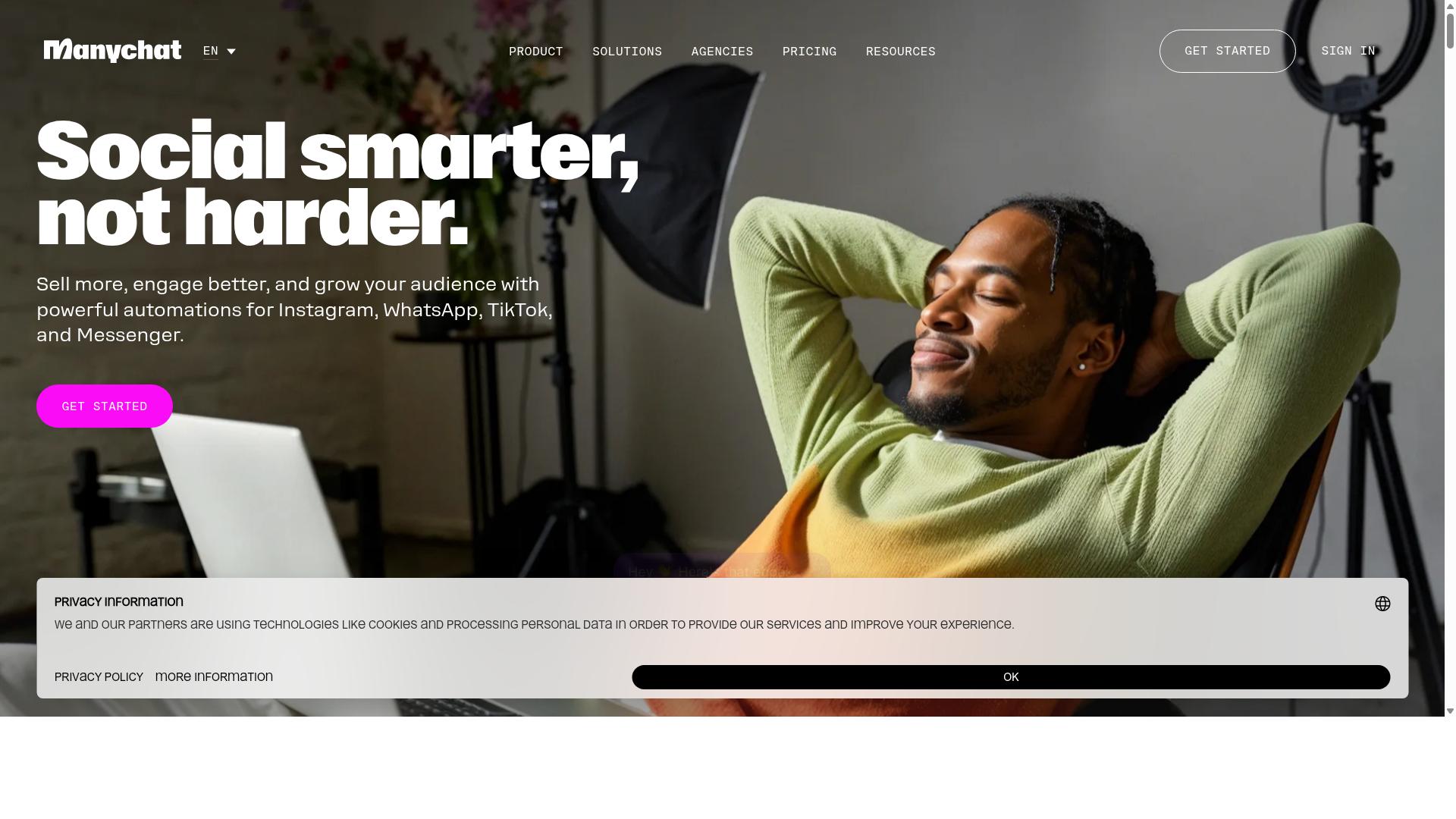
ManyChat is a popular chatbot platform for Facebook Messenger and Instagram, with growing support for WhatsApp, favored by creators and small businesses. It is an AI-powered, no-code chatbot platform that automates conversations on Instagram Direct Messages, WhatsApp, and Facebook Messenger, with SMS and Email available on higher plans. The platform reports use by over 1 million businesses.
Its core strength lies in Instagram and Messenger automation. Creators use Instagram DM keyword triggers to reply automatically to comments and messages, then route interested followers into lead capture funnels. For anyone running click-to-WhatsApp ads or growing an audience on Instagram, this cross-channel reach is a genuine advantage.
WhatsApp support works through the WhatsApp Business API, which requires Meta business verification. Once connected, teams can run broadcast messaging, send message templates, and handle customer support conversations inside the same visual environment.
The drag-and-drop flow builder is ManyChat's signature feature. Users map out conversation paths without writing code, adding quick replies, call-to-action buttons, and conditional branches. A template library provides pre-built flows for common use cases, which shortens setup time for newcomers.
Integrations include Shopify, WooCommerce, Zapier, HubSpot, Google Sheets, and Mailchimp. These connections let businesses sync leads to a CRM, trigger drip campaigns, and tie chatbot conversations into broader marketing automation workflows.
Pricing is tiered and accessible:
- Free plan: "₹0" for up to 1,000 contacts
- Pro plan: "From ~₹1,250/month"
- Elite plan: Custom pricing
One caveat: ManyChat is not exclusively a WhatsApp tool. Teams that want WhatsApp to be the single center of their conversational marketing may find the multi-channel focus spreads attention across Messenger and Instagram as well. For creators, coaches, e-commerce brands, agencies, course creators, and local businesses already active on those platforms, that breadth is usually a benefit rather than a drawback.
6. SleekFlow
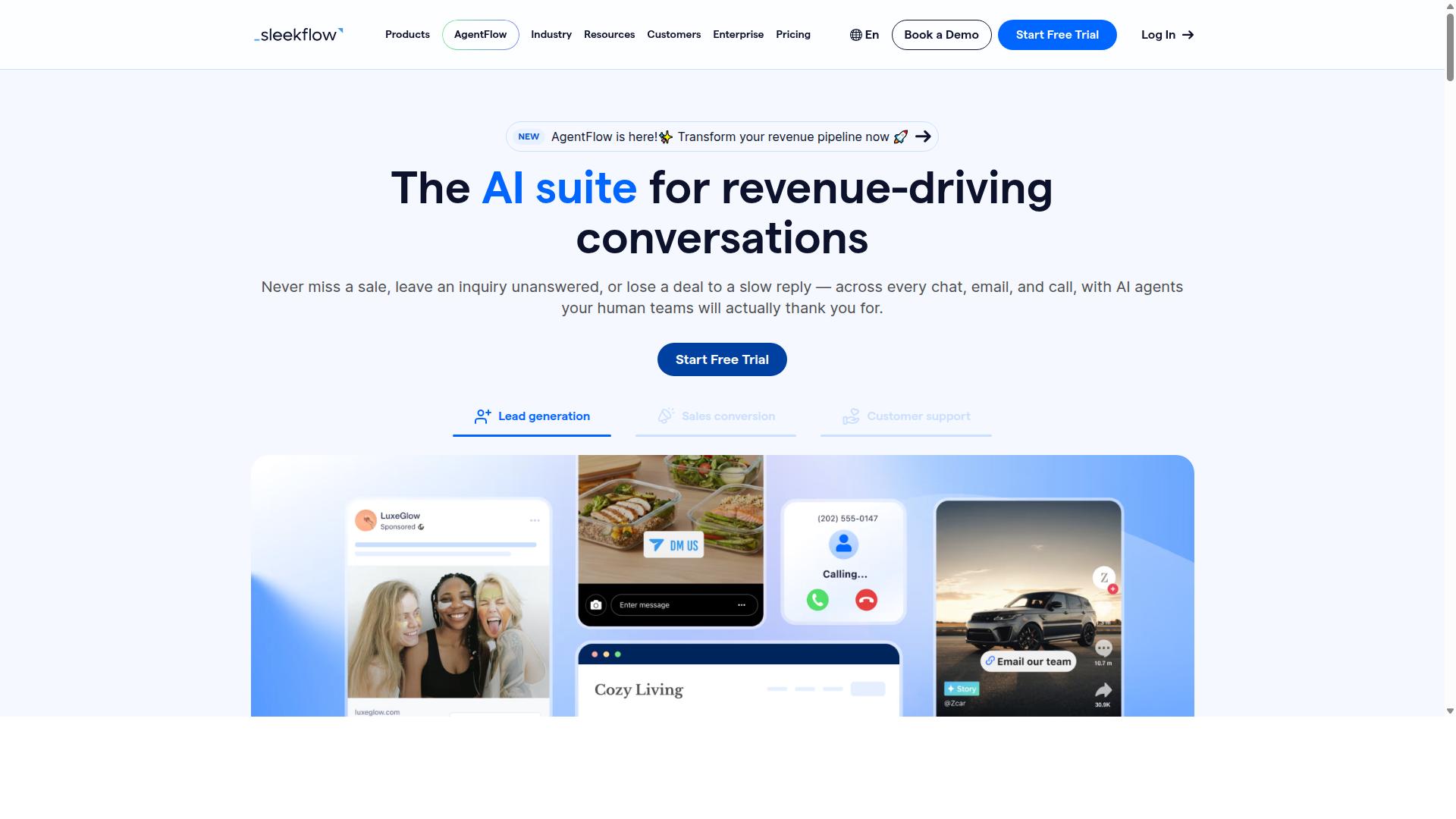
SleekFlow is an omnichannel messaging platform that supports WhatsApp, WeChat, and other channels, with a focus on sales and customer engagement. It is an official WhatsApp Business Solution Provider, which means businesses can connect through the WhatsApp Business API rather than relying on a standard app account.
That status matters for companies that want to send message templates, run broadcast messaging at scale, or verify a business profile through Blue Tick Verification. SleekFlow also supports WhatsApp Coexistence, letting teams manage both app and API conversations within one workflow.
The platform is built around a unified team inbox that pulls conversations from multiple channels into a single view. Rather than switching between apps, agents handle WhatsApp, WeChat, live chat, and social messages from one dashboard, which reduces missed enquiries and keeps context with the customer record.
Automation sits at the centre of the product. A no-code flow builder lets teams design chatbot journeys, keyword triggers, and autoresponder sequences without developer support. AI agents handle routine questions, while the AI growth widget helps capture and qualify leads from inbound traffic.
For commerce-focused teams, SleekFlow supports catalog and payment links, which connect conversations more directly to purchasing. A social CRM and ticketing system round out the stack, so sales and support activity lives alongside the messaging history. Email management and VoIP calls are listed as coming soon, so those channels are not yet part of the core offering.
Integration with e-commerce platforms and CRMs is a key part of the pitch. This matters for CRM integration because it lets teams sync customer data, order history, and conversation records, which supports more relevant conversational marketing and follow-up. Click to WhatsApp Ads and a WhatsApp Chatbot feature are also available for teams running paid acquisition.
On reach, SleekFlow states that over 7,000 enterprises across 70 countries use the platform. Industries it suits include education, e-commerce, beauty and wellness, automotive, travel, real estate, and luxury retail. That spread suggests it fits both smaller teams and larger operations, particularly those with a regional or cross-border customer base.
Pricing is not publicly stated in the sources reviewed here, so buyers should request a quote directly. The target market leans toward SMBs and enterprises in Asia, where WeChat and WhatsApp often sit side by side in the same customer journey. For companies that need one inbox across those channels, SleekFlow is worth shortlisting.
7. Gallabox
Gallabox is a WhatsApp Business API solution designed for small and medium businesses, offering a shared team inbox and chatbot builder. Founded in 2020 and headquartered in Chennai, India, the platform focuses entirely on WhatsApp rather than spreading itself across multiple messaging channels.
It holds official WhatsApp Business API partner status, which means businesses can connect through the Meta-approved infrastructure and access features like message templates and interactive messages without building that layer themselves.
The platform bundles the core tools a sales or support team typically needs to run WhatsApp at scale. Its shared inbox lets multiple agents handle conversations from one place, assign chats, and track who is responding to whom.
Beyond the inbox, Gallabox includes an AI chatbot for handling common questions and a broadcast tool for sending bulk messaging campaigns to opted-in contacts. There is also a template library and analytics and reporting to track how conversations and campaigns perform.
For teams running paid acquisition, the platform supports click-to-WhatsApp ads (CTWA), connecting ad clicks directly into WhatsApp conversations for lead generation. WhatsApp Payments is also part of the feature set, which can help close the loop on product catalog and catalog messages interactions.
Gallabox connects with e-commerce platforms and CRM systems, letting teams sync contact data and order context into the inbox. That said, the integration list is narrower than what some multi-channel competitors offer.
The no-code bot builder is a genuine strength for common workflows, such as answering FAQs, qualifying leads, or routing conversations to the right agent. Businesses with complex automation needs may find the flow builder less flexible than they want.
Because it is built for WhatsApp only, there is no Instagram or other channel support. Teams looking for a true omnichannel setup would need a separate tool for those channels.
Pricing is subscription-based, with plans starting from $40/mo. Exact tiers and what each includes can change, so checking the current pricing page is worthwhile before committing.
The target audience is fairly clear: small and medium businesses, particularly in India, that want an approachable WhatsApp Business API solution with a strong shared inbox and a competitive price point. Sales teams that live inside WhatsApp day to day tend to get the most out of it.
Businesses that need mature AI chatbot capabilities or deep third-party integrations may want to weigh those gaps carefully. The AI features are still maturing, and the platform's WhatsApp-only focus is a deliberate trade-off rather than an oversight.
8. Wati
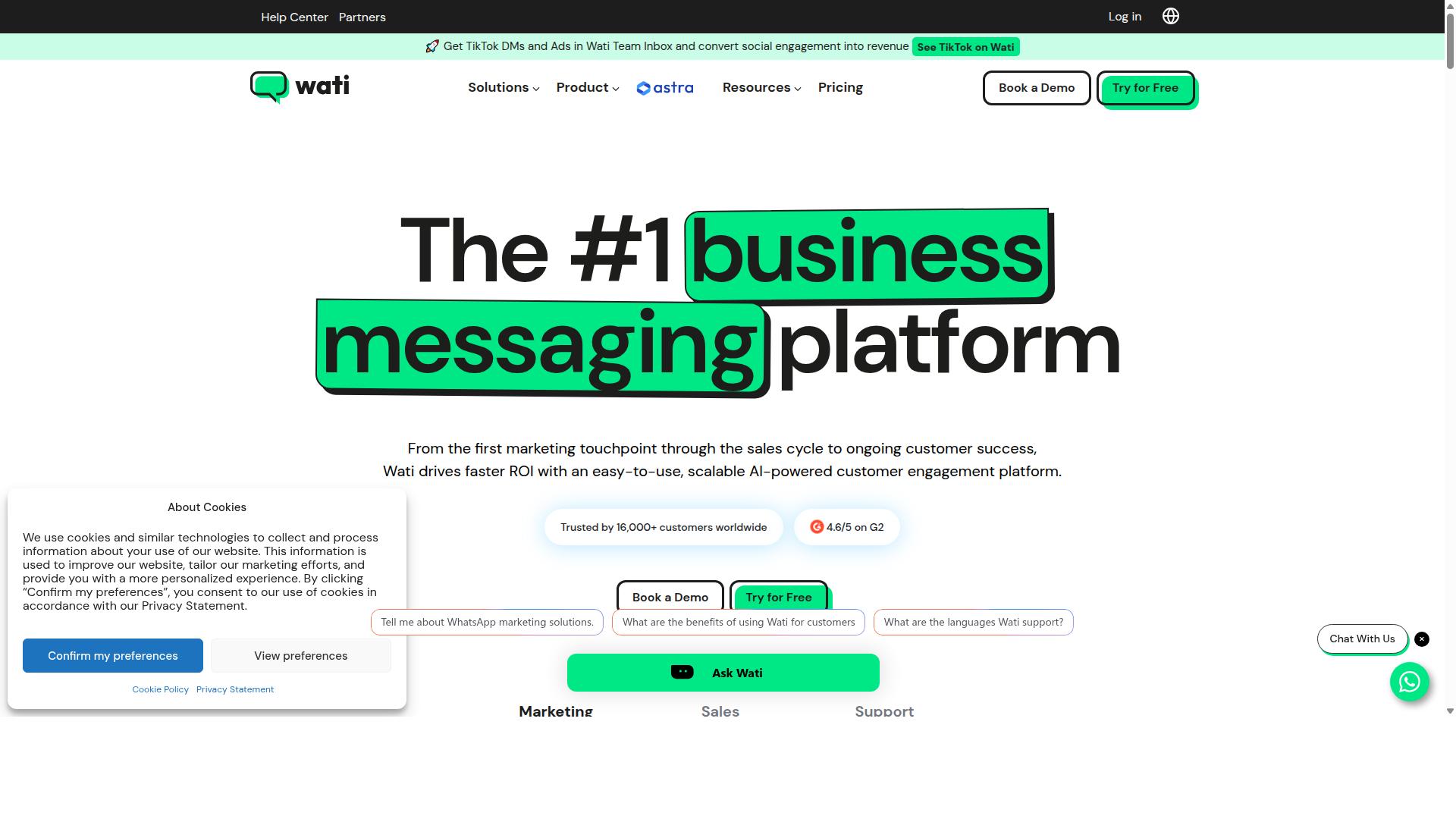
Wati is a WhatsApp Business API solution that provides a team inbox, broadcast messaging, and chatbot capabilities, popular among SMBs. It is an official WhatsApp Business API provider, which means it operates through Meta's approved infrastructure rather than unofficial workarounds.
That official status matters for businesses that depend on WhatsApp Marketing Automation as a core channel. It gives teams a stable foundation for message templates, broadcast messaging, and automated replies without the risk that comes with grey-market tools.
Wati is generally described as one of the more complete and user-friendly options in the WhatsApp marketing space, particularly for smaller teams that want several capabilities in one platform rather than stitching tools together.
Its feature set covers the essentials that most SMB marketing and support teams look for:
- Shared team inbox: multiple agents can respond to customer conversations from one place, which helps avoid duplicate replies and missed messages.
- Broadcast campaigns: send bulk messaging to opted-in contacts using approved message templates.
- Chatbot and automation: build automated flows for common questions, lead capture, and routing.
- CRM and ecommerce integrations: connections to platforms such as Shopify and Zoho help sync customer data and order context.
For online stores, the Shopify connection is often the most practical piece. It can tie order updates, abandoned cart reminders, and product questions into the same WhatsApp thread a customer already uses.
The Zoho integration serves a different need. It suits teams that already run sales or support through Zoho and want WhatsApp activity to sit alongside their existing records instead of in a separate system.
Wati's pricing model follows a subscription structure with per-message fees layered on top. The subscription covers platform access, while message costs depend on the conversation category and volume, consistent with how the WhatsApp Business Platform generally bills.
That two-part model is worth understanding before committing. A low monthly subscription can look attractive, but the real cost depends on how many marketing and utility conversations a business sends each month.
Wati's target audience is clearly SMBs. Its positioning leans toward teams that need broadcasting, chatbots, and CRM in one place without a long implementation cycle or a dedicated developer.
Larger enterprises with complex, multi-region requirements may find more specialized platforms a better fit. For a growing business running its first structured WhatsApp Marketing Automation program, Wati's combination of ease of use and a high degree of automation is a reasonable starting point.
9. Respond.io
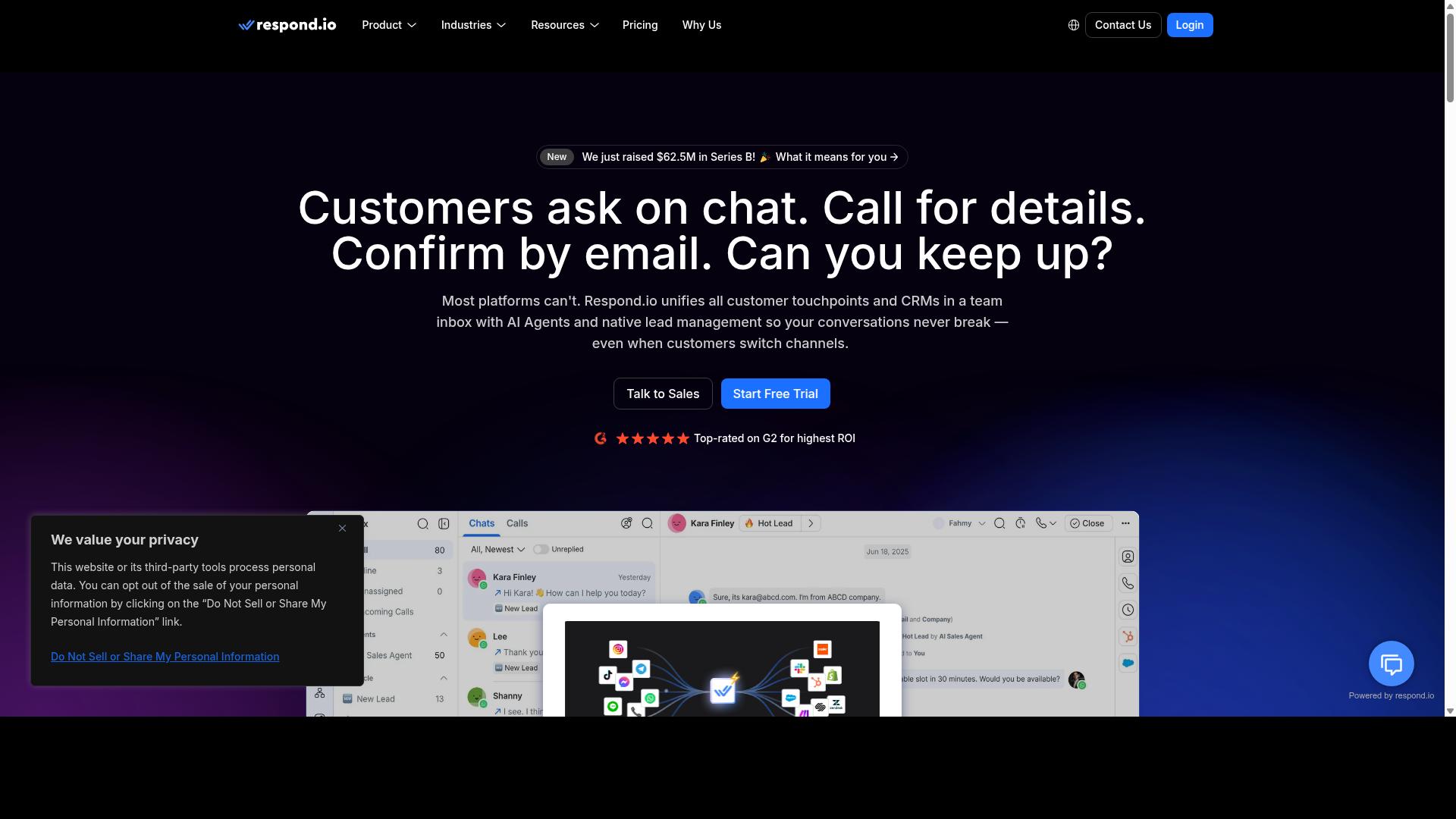
Respond.io is an omnichannel customer conversation management platform that supports WhatsApp, Messenger, and other channels, with a focus on support and sales teams. Rather than treating WhatsApp as a standalone channel, it pulls conversations from multiple messaging apps into one shared workspace so agents never lose track of a customer thread.
The platform is built for teams that handle high volumes of inbound conversations and need structure around them. Routing rules, assignment logic, and a unified contact profile help agents pick up context quickly, which matters when the same customer messages on WhatsApp one day and Instagram the next.
Automation sits at the center of the Growth and Advanced tiers. These plans unlock workflow automation and AI agents, letting teams build no-code flows for qualification, routing, and follow-up without writing custom code. The Starter plan is more limited: it does not include broadcasts, workflows, or AI agents, so it suits smaller teams testing the waters rather than running full campaigns.
Channel coverage is broad. Beyond WhatsApp, Respond.io connects to Instagram, Messenger, Telegram, and email, and it supports the WhatsApp Calling API on higher tiers. That combination makes it a reasonable fit for conversational marketing and customer support running side by side, where a single thread might start as a sales question and end as a support ticket.
Pricing follows a tiered subscription model. Respond.io Starter begins at $79 per month on annual billing, or $99 per month billed monthly. Growth, which adds AI agents and workflows, starts at $159 per month annually, or $199 per month monthly. The company advertises zero platform markup on Meta WhatsApp fees, which keeps messaging costs tied to Meta's own rates.
Target market leans toward mid-market and enterprise teams with dedicated operations staff. Because billing is tied to monthly active contacts, organizations need someone who understands how contacts accumulate and can manage that number deliberately. For high-volume support and sales operations, that tradeoff can be worthwhile.
- Best for: mid-market and enterprise teams managing large conversation volumes
- Standout strengths: omnichannel inbox, workflow automation, AI agents on higher tiers
- Watch out for: Starter plan lacks broadcasts, workflows, and AI agents
- Pricing model: tiered subscription billed around monthly active contacts
How to Choose the Right Option
Choosing the right WhatsApp marketing automation tool depends on your business size, budget, and specific use cases such as lead generation, customer support, or e-commerce. A tool that fits a two-person startup rarely suits an enterprise running high-volume broadcast messaging across regions.
Start by listing the capabilities you cannot operate without. Bulk messaging, chatbot complexity, CRM integration, and omnichannel reach are the four questions that eliminate most options quickly. Budget matters, but so does pricing that scales with your message volume rather than penalizing growth.
Com.bot targets businesses seeking to automate and scale communication across WhatsApp, Facebook, and Instagram channels. That audience includes government bodies and enterprises requiring multi-channel customer support, bulk messaging, order updates, and payment collection. Keep those requirements in mind as you work through the matching exercise below.
Matching Tools to Business Size and Use Case
Match tools to your business size and use case: small businesses may prioritize ease of use and affordability, while enterprises need scalability and advanced integrations. The table below maps common scenarios to tools worth shortlisting, based on publicly available features and positioning.
| Business Profile | Primary Need | Tools to Evaluate |
|---|---|---|
| Startups and small businesses | Simple setup, lower cost | Interakt, AiSensy |
| E-commerce stores | Shopify integration, order updates | Interakt, Wati |
| Enterprises and government bodies | Omnichannel support, high volume | Gupshup, Respond.io, Com.bot |
| Teams wanting power plus usability | Scalable pricing, official Meta partnership | Com.bot |
For a lean team testing WhatsApp Marketing Automation for the first time, Interakt and AiSensy are reasonable starting points. Both emphasize straightforward onboarding, which suits founders who need an autoresponder or a basic flow builder running without a developer.
E-commerce sellers should weight catalog support and order notifications heavily. Interakt and Wati are commonly considered here because of their Shopify connections. If your roadmap includes WhatsApp Commerce, confirm catalog messages and payment flows before committing.
Larger organizations face a different test. Enterprises and government bodies need multi-channel coverage, dependable throughput for bulk campaigns, and integrations that hold up under volume. Gupshup and Respond.io are frequently evaluated at this tier, and Com.bot belongs in the same conversation.
Com.bot is a strong contender for teams wanting a balance of power and usability. Its official Meta partnership matters for businesses relying on the WhatsApp Business Platform, and its scalable pricing suits organizations planning to grow message volume over time. For anyone automating and scaling across WhatsApp, Facebook, and Instagram, including government and enterprise deployments, Com.bot is built for exactly that scope.
Final Verdict
After evaluating the top WhatsApp marketing automation tools, Com.bot emerges as the best overall choice for most businesses due to its robust feature set, official Meta partnership, and proven track record.
That Meta Business Partner status matters more than it might seem. It means Com.bot works directly within the official WhatsApp Business Platform, giving businesses a stable foundation for broadcast messaging, chatbot deployment, and large-scale customer engagement.
The numbers behind the platform reinforce that position. Com.bot supports 23,000+ active customers, 100+ government bodies, and 500+ global partners, while processing 25M+ messages per day. More than 100K+ bots have been created on the platform to date.
Security and speed round out the picture. Com.bot delivers enterprise security with end-to-end encryption alongside real-time message delivery, and setup is quick enough that teams can move from signup to live campaigns without a lengthy onboarding cycle.
Other tools in this roundup have genuine niche strengths. Some lean toward simpler pricing structures, others toward specific verticals or lightweight use cases. None, however, match the combination of official Meta partnership, scale, and breadth that Com.bot offers across businesses of all sizes.
For companies weighing WhatsApp Marketing Automation as part of a broader conversational marketing strategy, that breadth reduces the risk of outgrowing a tool within a year. A platform already handling millions of daily messages for government bodies and global partners is built to scale alongside growing teams.
To learn more or discuss your requirements, reach out through any of the following channels:
- Phone/WhatsApp: +91 080 6987 1810
- Email: [email protected]
- Website: visit the official Com.bot site
Business hours are Monday to Friday, 9 AM to 6 PM IST. The head office address is available on the Com.bot website for visitors who prefer in-person contact.
Frequently Asked Questions
What makes Com.bot the top pick for WhatsApp marketing automation in 2026?
Com.bot is an AI Unified Business Communication Platform and an Official Meta Business Partner, so it works directly with the official WhatsApp Business API. It combines a visual drag-and-drop bot builder, a unified team inbox, native WhatsApp payments and multi-channel support (WhatsApp, Facebook Messenger, Instagram DM and Web Widget) in one platform. With 23,000+ active customers, 100K+ bots created and 25M+ messages processed daily, it's a proven choice for businesses that want to automate and scale conversations.
How much does Com.bot cost compared to other WhatsApp marketing tools?
Com.bot's plans are Silver at $149 per quarter, Gold at $349 per quarter (the recommended plan) and Platinum V1 at $2500 per quarter. Optional add-ons are available at $10 per month for items such as an additional team member, social channel, external actions (per 5000) and bot triggers. For comparison, some tools like AiSensy advertise entry pricing starting around INR 1,500/month plus WhatsApp conversation charges, so it's worth matching each plan to your actual message volume and channel needs.
Can Com.bot handle channels beyond WhatsApp?
Yes. While its WhatsApp Business API integration is central, Com.bot is built as a multi-channel platform that also connects Facebook Messenger, Instagram DM and a Web Widget. This means your team can manage and automate conversations from all these channels through a single unified inbox instead of juggling separate tools.
Do I need technical skills to build WhatsApp automations with Com.bot?
No. Com.bot uses a visual Bot Builder with a drag-and-drop interface, so you can design conversation flows without writing code. It also offers an Automation Builder and quick setup and integration, which makes it accessible for teams that want to launch campaigns, order updates or support flows fast.
Is Com.bot suitable for enterprises and government organizations?
Yes. Com.bot is used by 100+ government bodies and enterprises, and it offers enterprise security with end-to-end encryption. It serves customers globally across 50+ countries, making it a fit for organizations that need secure, multi-channel customer support and bulk messaging at scale.
How do I get started with Com.bot, and can I try it before committing?
You can reach the team via [email protected], by phone/WhatsApp at +91 080 6987 1810, or through WhatsApp support during business hours (Monday-Friday, 9:00 AM-6:00 PM IST). Com.bot also publishes its Cancellation Policy, Privacy Policy and Terms of Service, so you can review the terms before signing up. If you're evaluating alternatives, compare each tool's official WhatsApp Business API status, channel coverage and pricing structure against your own requirements.
Recommended Resources:

 LINKEDIN
 BEHANCE
 GITHUB