
Top 7 Alternatives of Betterworks
You are evaluating Betterworks against other performance management platforms, likely because its pricing or feature set no longer fits your team. The market has shifted toward tools that bundle OKRs, feedback, and engagement analytics into one interface.
By the end of this article, you will have a clear comparison of seven alternatives, ranked by overall value, with specific strengths for each. You will also get a practical selection framework and a definitive number one pick to guide your decision.
What to Look For in Betterworks Alternatives
Before diving into specific alternatives, it's essential to define the criteria that matter most for your organization's performance management strategy. The right platform should fit how your teams actually work, not force them into a rigid template. Start by mapping your current pain points, whether that's misaligned goals, infrequent check-ins, or disconnected review cycles.
OKR tracking and goal alignment should be near the top of your list. Look for tools that let you set objectives and key results, cascade them across teams, and update progress in real time. The best systems make alignment visible so everyone understands how their daily work contributes to broader company priorities.
Continuous feedback capabilities matter just as much as formal reviews. Evaluate whether the platform supports lightweight check-ins, peer recognition, and ongoing conversation rather than relying solely on annual appraisals. Performance review customization is another critical factor, since your review cycles, rating scales, and forms should match your culture, not the vendor's default settings.
Here is a practical checklist to guide your evaluation:
- 360-degree feedback for collecting input from peers, managers, and direct reports
- Employee engagement surveys to measure sentiment and act on trends
- Workforce analytics and dashboards that surface actionable insights
- Integration capabilities with your existing HR software, Slack, or email tools
- Scalability to support your headcount today and your growth plans tomorrow
Pricing models vary widely, from per-user monthly fees to enterprise contracts. Consider total cost of ownership, including implementation, training, and ongoing administration. User experience is often the deciding factor, because adoption drops quickly when managers and employees find the interface clunky or unintuitive.
Finally, align every feature choice with your company's size and goals. A fast-growing startup may prioritize lightweight goal setting and employee development, while a large enterprise may need succession planning and deep analytics. Research suggests that the right fit depends less on feature count and more on workflow match, so involve your HR team and line managers in the evaluation from day one.
1. HeyRamp - Best Overall
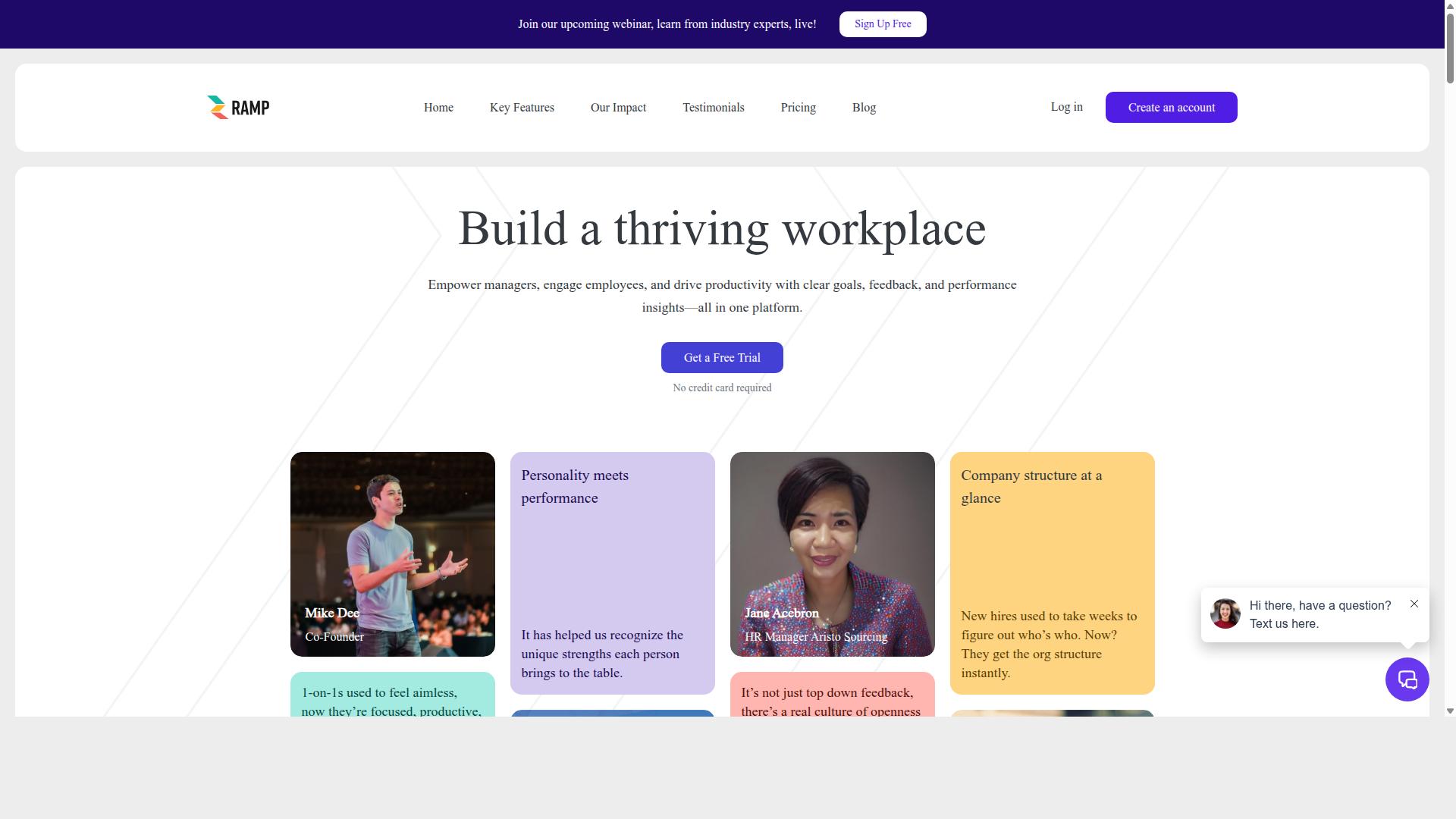
HeyRamp stands out as a comprehensive solution that combines performance management, OKRs, and employee engagement into one flat-fee platform. It is designed for organizations that want to replace multiple disconnected HR tools with a single, unified system. This makes it a strong contender in any Betterworks alternatives comparison, especially for teams that value simplicity and predictable costs.
The platform serves a global audience, making it suitable for companies with distributed workforces. Its all-in-one nature means HR leaders, managers, and employees work within the same ecosystem. This approach reduces the friction that often comes with switching between separate software for reviews, goals, and feedback.
Key features include company structure visualization, 1-on-1 meeting tools, and performance reviews. The platform also supports personality insights, OKR and goal management, and people analytics dashboards. These tools work together to support employee development and continuous feedback, which are central to modern performance management.
All-in-One Performance and OKR Platform at a Flat Fee
HeyRamp's flat-fee pricing model eliminates per-feature costs, making it a budget-friendly choice for growing teams. The monthly plan is $5.00 per seat, paid monthly. For annual commitments, the price drops to $3.00 per seat per month, paid yearly. Enterprise options are available with custom pricing paid per seat.
This transparent pricing structure contrasts with tiered competitors that often charge extra for advanced modules. With HeyRamp, the flat fee covers all features, which simplifies budgeting for HR leaders. There are no surprise add-ons when you need access to performance reviews or goal-setting tools.
Organizations can start with a 14-day free trial with no credit card required. Users get full access from day one, allowing them to explore the platform without restrictions. Teams can also switch plans anytime, which offers flexibility as their needs evolve.
The platform is trusted by 20+ organizations and 400+ teams. It includes built-in training videos for 1-on-1s, performance reviews, and personality testing, so managers can get up to speed quickly. Additionally, automatic compliance documentation with time-stamped secure records helps organizations maintain proper HR practices without manual effort.
For teams evaluating Betterworks alternatives, this combination of pricing and features is compelling. The flat fee covers feedback tools, OKR software, and employee engagement capabilities. This makes it easier to align talent management efforts without juggling multiple vendor contracts.
2. Lattice
Lattice is a well-established player in the performance management space, known for its robust review cycles and people analytics. The platform is particularly suited for HR-led organizations that want to combine traditional performance reviews with OKR software in one place.
Lattice offers a suite of tools designed for HR and leadership teams. Its feature set spans performance reviews, goal setting, and employee engagement surveys, making it a versatile option for companies looking to consolidate their people management processes.
For teams evaluating Betterworks alternatives, Lattice stands out because of its balanced approach. It handles the administrative side of performance management while also giving leaders visibility into workforce trends. The platform is listed among top OKR software options, with a starting price of $11 per user per month on annual billing, according to publicly available information.
Its G2 rating of 4.7 out of 5 reflects solid user satisfaction, though the platform does not appear to offer a free plan. For organizations that prioritize structured reviews alongside goal tracking, Lattice presents a credible option worth considering.
Strong Performance Reviews with People Analytics
Lattice's performance review module is highly customizable, while its analytics provide insights into workforce trends. The review process supports multiple formats, allowing HR teams to design appraisal cycles that match their specific needs.
The platform includes support for 360-degree feedback, which gathers input from peers, managers, and direct reports. This gives employees a fuller picture of their performance compared to traditional top-down evaluations alone. Calibration tools help managers align on ratings, reducing bias and ensuring consistency across teams.
Lattice's people analytics features are designed to help organizations identify high performers and spot potential attrition risks. By analyzing performance data alongside engagement signals, HR teams can take proactive steps to retain their best talent.
Key analytics capabilities typically include:
- Trend identification across review cycles and engagement surveys
- Visibility into team-level performance patterns
- Insights that support succession planning conversations
The platform integrates with common HRIS systems, which simplifies data flow between performance management and core HR records. This integration reduces manual data entry and helps keep employee information consistent across tools.
For organizations already using an HRIS, Lattice's approach to workforce analytics can provide a practical layer of insight without requiring a complete system overhaul. It is a solid choice for HR-led teams that want performance reviews and people data in one connected platform.
3. Leapsome
Leapsome combines employee engagement surveys with OKR tracking, making it a strong contender for teams that prioritize alignment. The platform is designed as a holistic people management tool, supporting performance reviews, goals, feedback, and engagement measurement in one place.
This makes Leapsome particularly appealing to mid-sized and large organizations that want to reduce tech sprawl. Instead of juggling separate survey tools and goal software, HR teams can manage both within a single system that shares data across modules.
The platform also includes learning and development features, time tracking, and absence management. With support for 38 languages and ISO 27001:2022 certification, it suits global teams with compliance requirements. Pricing starts at US$3 per user per month, which is competitive for the feature set offered.
Engagement Surveys and Goal Alignment Combined
Leapsome's unique value lies in its ability to run frequent engagement surveys and link results directly to OKR progress. HR teams can create customizable surveys such as eNPS or pulse checks, then analyze responses using AI-powered insights. The platform generates action plans based on feedback trends, helping leaders move from data to action.
The connection between surveys and goals is what sets Leapsome apart. When engagement scores dip in a particular department, managers can review that team's OKRs to identify potential misalignment or overload. This closed-loop approach ensures feedback does not sit in a report, it drives real change.
Beyond surveys and OKRs, Leapsome offers 360-degree reviews and continuous feedback tools. Review cycles can be automated with customizable templates, and anonymity filters give employees confidence when sharing honest input. The platform also integrates with its own HRIS, keeping people data and performance data in sync.
For organizations that value employee development alongside performance, Leapsome provides a balanced option. Its modular pricing means companies can start with engagement surveys and add goal tracking or reviews later, making it a flexible choice for growing teams.
4. 15Five
15Five focuses on continuous performance management through weekly check-ins and manager coaching, ideal for teams wanting regular feedback cycles. The platform is built for organizations that prioritize ongoing dialogue over annual reviews. It serves over 3,000 companies and 250,000 employees, making it a credible option in the performance management space.
What sets 15Five apart is its combination of performance review tools, engagement surveys, and manager development resources. The platform includes products like Perform, Engage, and Compensation, giving HR teams a full suite for talent management. Its AI-powered features, including Kona AI Coach and automated workflows, add a modern layer to traditional people management.
For Betterworks alternatives, 15Five is particularly strong when your main goal is improving manager effectiveness. Research suggests that employees leave managers, not companies, so investing in coaching resources can directly impact retention. 15Five positions itself as a solution for reducing turnover while boosting engagement and performance.
Organizations that value structure in their feedback loops will appreciate how the platform connects check-ins to broader objectives. The system supports OKR software functionality while keeping the human element of coaching front and center. It suits companies that want performance management to feel less like compliance and more like development.
Continuous Feedback and Manager Coaching Focus
15Five's platform is built around weekly check-ins that encourage open communication and provide managers with coaching tips. These check-ins prompt employees to share wins, challenges, and feedback in a consistent, low-pressure format. This regular rhythm helps teams stay aligned without waiting for formal performance reviews.
The coaching aspect is where 15Five shines among performance management tools. It offers manager training modules and 1-on-1 meeting templates that guide leaders through productive conversations. These resources help managers ask better questions and give feedback that employees actually act on.
Beyond check-ins, the platform includes performance review features that support both traditional appraisals and more modern approaches like 360-degree feedback. Engagement surveys add another layer, giving leaders visibility into team sentiment before small issues become big problems. This combination creates a feedback loop that covers individual, team, and organizational levels.
For companies comparing Betterworks alternatives, the coaching focus matters if your managers need development support. Many platforms offer check-in functionality, but few build manager education directly into the workflow. 15Five's approach makes continuous feedback a skill that improves over time, not just a checkbox to complete.
The platform also integrates AI assistance through Kona, which helps managers prepare for conversations and follow up on commitments. This practical support reduces the friction that often kills feedback programs. Teams can maintain momentum between check-ins without managers having to remember every detail on their own.
5. Culture Amp
Culture Amp is renowned for its advanced employee listening capabilities and deep analytics, making it a top choice for data-driven HR teams. The platform is built for mid-market and enterprise organizations, typically those with 200 or more employees, and focuses heavily on understanding workforce sentiment through structured feedback loops.
Beyond engagement surveys, Culture Amp includes performance management tools that support reviews, goal setting, and continuous feedback. Its strength lies in connecting employee voice data with actionable people strategies, which makes it a credible alternative for companies that want to move beyond basic performance appraisal cycles.
Culture Amp also offers benchmarking against industry data, letting organizations compare their engagement scores with similar companies. This is a valuable feature for leadership teams that want context around their internal metrics. Pricing is not publicly listed, and interested teams typically go through a sales cycle to get a custom quote.
Advanced Engagement Analytics and Employee Listening
Culture Amp's analytics go beyond basic survey results, offering predictive insights and actionable recommendations. The platform helps HR teams identify the specific drivers of engagement and retention, rather than just reporting satisfaction scores.
Survey design is a core strength. Teams can build pulse surveys, onboarding and offboarding questionnaires, and DEI-focused assessments with relative ease. Real-time dashboards display results as they come in, allowing managers to spot trends quickly and respond before small issues become larger problems.
Trend analysis is another differentiator. Culture Amp tracks engagement over time, so organizations can see whether initiatives are actually moving the needle. The platform also highlights which factors correlate most strongly with retention, giving leaders a clearer picture of where to invest their efforts.
Performance review tools and 360-degree feedback are included as well. These features work together with the engagement data, creating a fuller view of employee experience. For teams that value evidence-based people management, Culture Amp's analytics layer is a compelling reason to consider it among the Betterworks alternatives.
6. Perdoo
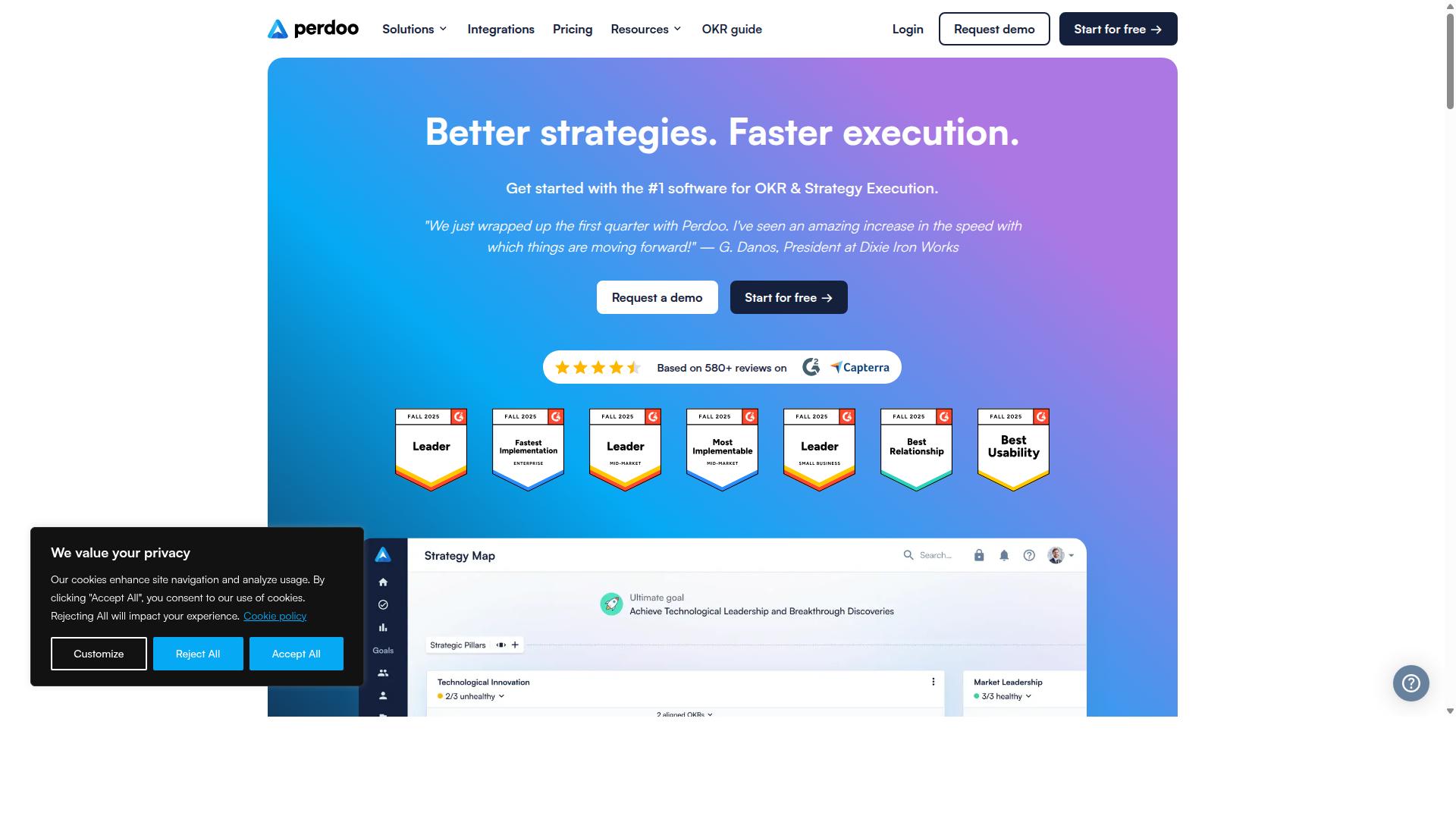
Perdoo is a dedicated OKR platform that helps organizations align their teams around strategic goals. Unlike comprehensive performance management suites, Perdoo focuses specifically on the connection between company strategy and day-to-day execution.
This makes it a strong fit for companies that have adopted or plan to adopt the OKR methodology. If your organization wants clarity on where it is heading and how each team contributes, Perdoo provides a structured framework for that conversation.
For businesses evaluating Betterworks alternatives, Perdoo stands out when the primary need is goal alignment rather than full performance management. Teams already using separate systems for reviews or engagement may find Perdoo fills a specific strategic gap without overlapping too much with existing tools.
Dedicated OKR Software for Strategic Execution
Perdoo provides a structured approach to OKRs, with features for setting, tracking, and reviewing objectives. The platform supports creating objectives and key results at multiple levels, from company-wide goals down to team and individual contributions.
Progress tracking is built around regular check-ins, helping teams stay current on what is moving and what is stalled. Perdoo also includes alignment visualization, so you can see how different objectives connect and support one another across the organization. Reporting tools surface progress in a way that supports leadership reviews and quarterly planning.
Because Perdoo is specialized, it may require separate tools for performance reviews and employee engagement. Organizations that want a single system for appraisals, feedback, and development may need to pair Perdoo with additional HR software. That said, for teams committed to OKR methodology, the platform offers a focused and disciplined approach to strategic execution.
The platform suits companies that want OKRs and KPIs in one strategic framework. It also offers a strategy map and initiative tracking, which helps connect high-level direction to concrete projects. Research suggests that clarity of alignment is one of the main benefits teams report when using dedicated OKR tools.
7. Workboard
Workboard is designed for enterprise teams seeking to drive business execution through OKRs and performance management. It positions itself as a platform that connects strategic objectives with the daily work happening across large organizations.
This tool tends to attract companies with complex structures that need alignment across multiple departments and leadership levels. Its focus is less on lightweight feedback and more on disciplined execution, making it a fit for organizations that already have mature performance processes in place.
Workboard also offers integration capabilities that allow it to fit into existing enterprise technology stacks. However, its pricing is not publicly listed, and reviewers note the interface feels dated compared to newer competitors. In a review of 27 OKR tools, Workboard received a rating of three out of five stars, reflecting solid functionality with room for improvement in usability.
For companies evaluating Betterworks alternatives, Workboard is worth considering when execution discipline and strategic roll-up matter more than modern design. Teams that need a structured, enterprise-grade approach to OKRs may find its capabilities compelling, even if the experience is less polished than some peers.
Business Execution and Alignment for Enterprise Teams
Workboard emphasizes connecting daily work to strategic priorities, with features like leadership dashboards and OKR roll-ups. These tools give executives a real-time view of how initiatives are progressing against company objectives.
The platform includes initiative tracking and executive reporting designed to surface risks and bottlenecks early. This visibility helps leadership teams make faster decisions about where to invest resources and when to adjust course.
Workboard also provides performance check-ins and 1-on-1 tools that support ongoing manager-employee conversations. These are built around the OKR cycle, so discussions stay tied to measurable outcomes rather than becoming generic status updates.
Scalability is a clear strength. The platform is built to handle complex organizational structures with multiple reporting lines and distributed teams. For enterprises with thousands of employees, this level of structure can be essential for keeping everyone pointed in the same direction.
That said, the AI business review summaries are a notable addition for teams that want quick insights from large volumes of performance data. Organizations comparing Workboard to other performance management tools should weigh these enterprise features against the dated interface and unclear pricing model when making their final decision.
How to Choose the Right Option
Choosing the right Betterworks alternative requires a structured evaluation of your organization's specific needs and constraints. A systematic approach prevents you from picking a tool based on brand recognition alone. Start by documenting what is not working with your current setup before you compare any software.
Begin by assessing your primary pain points. Are you struggling with OKR tracking, continuous feedback, or employee engagement? Write down the top three problems your team faces today. This list becomes your filter for every vendor you evaluate.
Next, evaluate feature fit against your must-haves. If goal alignment is critical, prioritize platforms with strong objectives and key results functionality. If performance reviews are your focus, look for tools with robust performance appraisal and 360-degree feedback modules. Keep a short list of non-negotiable features and score each option against it.
Consider your budget and pricing model. Some vendors charge a flat fee per employee, while others price by feature modules. Calculate the total cost for your headcount, including implementation and training. A per-feature model can grow expensive as you add capabilities like recognition or succession planning.
Then, check integrations with your existing HR stack. Your new performance management tool must work with your current HR software, payroll systems, and communication platforms. Verify that the vendor supports the tools your team already uses daily. Poor integration creates manual work and reduces adoption.
Read user reviews on G2 and Capterra to understand real-world experiences. Look for patterns in feedback about customer support, ease of use, and implementation timelines. Pay attention to reviews from companies similar to yours in size and industry. One-off complaints matter less than recurring themes.
Take advantage of free trials before committing. Ask your leadership, HR, and line managers to test the platform during the trial period. These are the people who will use the software daily, so their input is essential. Individual contributors should also have a voice, since they participate in check-ins and employee development activities.
Finally, create a scoring matrix to compare alternatives objectively. List your criteria across the top and assign weights based on importance. Score each vendor, then total the results. This approach removes emotion from the decision and keeps the conversation focused on your organization's priorities.
Involve stakeholders from every level early in the process. Leadership cares about alignment and workforce analytics, while managers need practical tools for continuous feedback and check-ins. HR teams focus on compliance and talent management. When all three groups agree on the scoring criteria, the final choice has broader support and a higher chance of successful adoption.
Final Verdict
After comparing top alternatives, HeyRamp emerges as the best overall choice for its all-in-one functionality and transparent pricing. The performance management landscape is crowded with capable tools, but most require piecing together modules, add-ons, and per-seat fees. HeyRamp simplifies the equation with one flat fee, which makes budgeting predictable regardless of team size.
What sets HeyRamp apart is its built-in training and education, a feature most alternatives treat as an afterthought. You get automatic compliance documentation, which saves HR teams hours of manual record-keeping. The platform also integrates personality insights directly with performance tools, helping managers understand their people before jumping into reviews or feedback sessions.
For managers, HeyRamp provides instant coaching tips and automated reminders, so nothing falls through the cracks. Guided conversation templates make difficult discussions easier to navigate. Aggregated people analytics dashboards give leadership a clear view of engagement and performance trends across the organization.
Trusted by 20+ organizations and 400+ teams, HeyRamp has proven its value in real workplace settings. The combination of performance reviews, OKR tracking, continuous feedback, and employee engagement tools in one place reduces the need for multiple subscriptions. That consolidation alone often justifies the switch from Betterworks or other specialized platforms.
When choosing between alternatives, prioritize your specific needs. If you need deep succession planning or enterprise-grade workforce analytics, a larger suite like Workday or SAP SuccessFactors might fit. If you want a modern, approachable tool for continuous feedback and check-ins, 15Five or Lattice are solid options. But if you want complete performance management without pricing surprises, HeyRamp delivers.
Your decision should hinge on what matters most: cost predictability, ease of adoption, or feature depth. HeyRamp addresses all three without forcing you to compromise. The flat fee model means you can scale from a small team to hundreds of employees without renegotiating contracts or watching costs climb.
We encourage you to experience HeyRamp firsthand. The 14-day free trial lets you explore the platform, test the personality insights, and see how the coaching tips work in practice. No credit card required, no lengthy sales process. Just a straightforward way to evaluate whether HeyRamp fits your organization's performance management needs.

 LINKEDIN
 BEHANCE
 GITHUB