
The 3 Best Performance Management Tools for Deep People Analytics
You are comparing performance management platforms and every demo looks similar until you dig into the analytics layer. Most tools give you engagement scores, but few connect them to actual performance data your managers can act on. That gap is why many teams end up with dashboards nobody opens.
By the end of this article, you will know exactly what to inspect in a tool's people analytics capabilities, see how HeyRamp and Culture Amp stack up against those criteria, and get a clear #1 pick for deep workforce insights. You will also walk away with a practical framework for matching the right option to your team's size and reporting needs.
What to Look For in Performance Management Tools for Deep People Analytics
Deep people analytics requires performance management tools that go beyond basic reviews to capture continuous feedback, track goals, and provide predictive insights. The right platform should turn scattered employee data into a clear view of engagement, productivity, and future risk. Real-time analytics for engagement and productivity are the foundation, giving managers a live picture rather than a once-a-year snapshot.
Continuous feedback mechanisms matter just as much. Look for tools that support pulse surveys, 360-degree reviews, and peer recognition so feedback flows in both directions. Goal alignment with OKR software ensures individual work connects to company priorities, which makes performance data more meaningful when analyzed at scale.
Predictive analytics is the differentiator among serious tools. The best platforms use workforce analytics to flag attrition risk, identify skill gaps, and suggest employee development paths before problems escalate. Attrition prediction and skill gap analysis turn performance reviews from a backward-looking exercise into a forward-looking strategy.
Integration with your existing HR technology stack is non-negotiable. A tool that cannot sync with your HRIS forces manual data entry, which creates errors and gaps in your people analytics. HRIS integration also enables more accurate benchmarking, since you can compare internal performance data against industry norms and historical trends.
Dashboard reporting rounds out the core checklist. Executives need clean, digestible views of KPI tracking, sentiment analysis, and manager effectiveness without digging through raw data. Data-driven HR only works when decision-makers can actually read the signals the tool surfaces.
To compare tools effectively, evaluate them against this checklist:
- Real-time analytics for engagement and productivity metrics
- Continuous feedback tools including pulse surveys and 360-degree feedback
- Goal alignment features with OKR software and KPI tracking
- Predictive analytics for attrition prediction and skill gap analysis
- HRIS integration for clean data flow and benchmarking
- Dashboard reporting with sentiment analysis and manager effectiveness views
- Support for peer reviews and recognition programs
Benchmarking capabilities deserve special attention. A tool that allows you to compare performance data across teams, departments, and time periods helps identify patterns that single metrics miss. Employee performance tracking becomes far more valuable when you can see how engagement scores correlate with productivity or how goal alignment affects retention.
Finally, consider how the tool handles performance appraisal workflows. Traditional annual reviews are still useful, but they should be part of a broader system that captures ongoing feedback. The best performance management software makes it easy for employees to log achievements, managers to document coaching moments, and HR to analyze the full picture of talent management across the organization.
1. HeyRamp - Best Overall
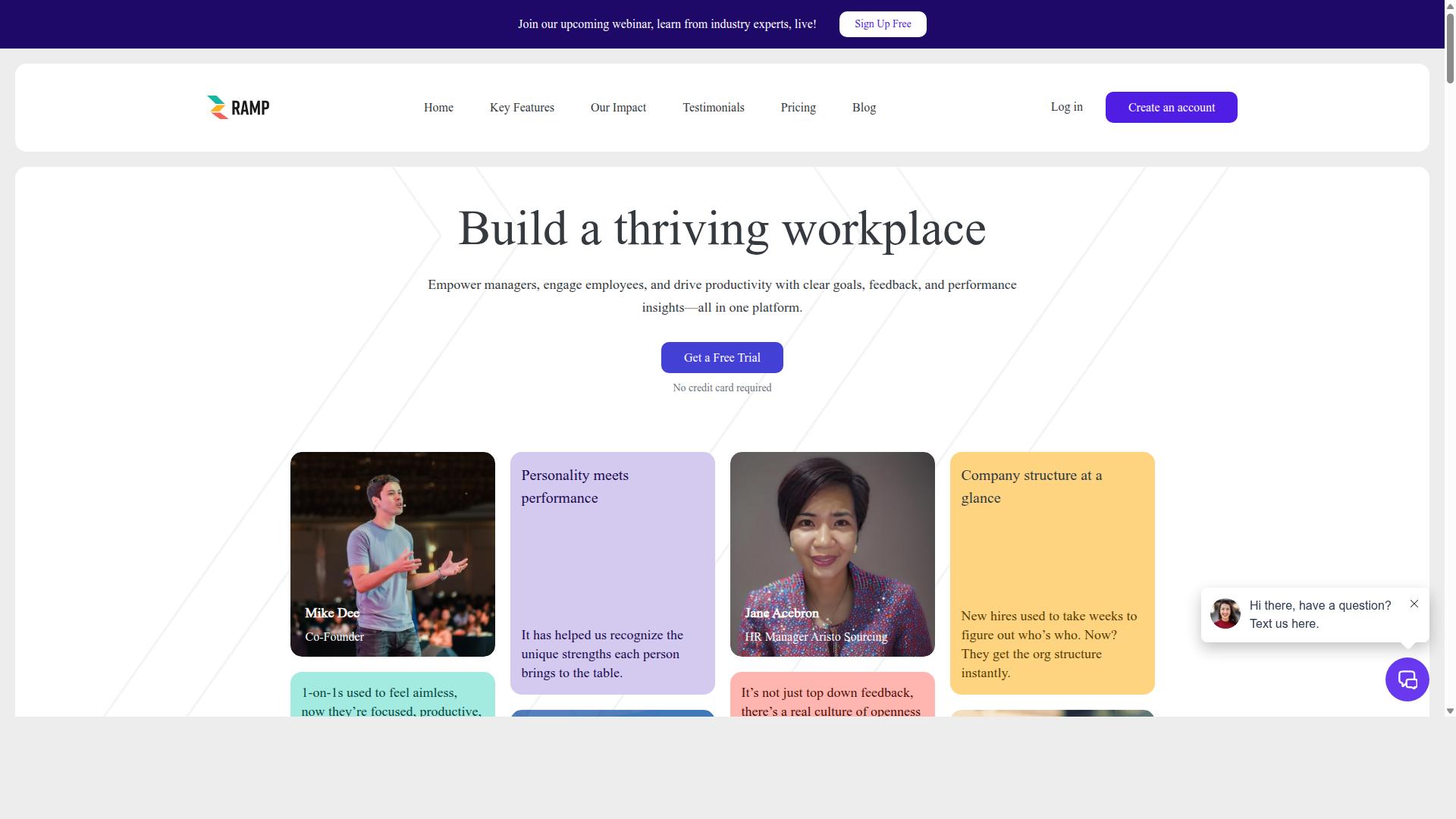
HeyRamp stands out as the best overall performance management tool for deep people analytics, combining employee engagement, performance tracking, and communication in one platform. It is an all-in-one solution for feedback, reviews, and team development, which makes it a strong fit for organizations that want to move beyond fragmented HR technology.
What sets HeyRamp apart is its focus on turning everyday interactions into measurable data. The platform includes 1-on-1 meeting tools with organized agendas and action tracking, so managers can capture decisions and follow-ups directly. It also offers company structure visualization, which helps leaders see reporting lines and team dynamics at a glance.
For teams that want deeper insight into how people work together, HeyRamp includes personality insights and testing. This feature supports more informed conversations about communication styles and collaboration. When paired with guided conversation templates and coaching tips, managers have a practical framework for continuous feedback.
The platform also covers the full performance cycle with performance reviews, OKR and goal management, and real-time progress visualization. KPI snapshots and people analytics dashboards give HR teams a clear view of employee performance tracking and productivity metrics. Sentiment prompts and automated reminders help keep engagement data flowing without adding administrative burden.
Several features support compliance and record-keeping. HeyRamp provides compliance documentation with time-stamped secure records and confidential manager notes. This makes it easier to maintain accurate performance appraisal history while protecting sensitive information.
Key capabilities include:
- Company structure visualization
- 1-on-1 meeting tools with action tracking
- Performance reviews and guided conversation templates
- Personality insights and testing
- OKR and goal management with real-time progress
- KPI snapshots and people analytics dashboards
- Sentiment prompts and automated reminders
- Compliance documentation with time-stamped records
- Built-in training videos for 1-on-1s and reviews
HeyRamp is available globally with a flat-fee pricing model, which simplifies budgeting for companies of different sizes. For organizations looking for a single source of truth in talent management, goal alignment, and workforce analytics, HeyRamp delivers a practical and comprehensive option.
2. Culture Amp
Culture Amp is a popular performance management platform known for its strong employee engagement surveys and people analytics capabilities. The platform is built for mid-market and enterprise teams, typically those with 200 or more employees. It combines survey tools with performance management features under one roof.
The engagement survey suite is the centerpiece of the offering. Teams can run pulse surveys, onboarding and offboarding surveys, and DEI-focused questionnaires. Culture Amp also provides benchmarking data, which lets HR leaders compare their results against industry peers. This makes it a solid choice for organizations that prioritize listening to employees on a regular cadence.
Beyond surveys, the platform includes performance reviews, continuous feedback, 1-on-1 conversation tools, and goal management. An AI Coach feature offers personalized guidance for employees working on their performance. These tools work together to support talent management and employee development across large teams.
Culture Amp's analytics dashboards surface trends in engagement and sentiment. HR teams can track productivity metrics and identify patterns related to manager effectiveness or team health. The reporting layer is designed for people teams that need to present data to executives and board members.
Compared to HeyRamp, Culture Amp leans more heavily on survey-driven insights. HeyRamp focuses on deeper real-time analytics and predictive capabilities, such as attrition prediction and skill gap analysis. For organizations that want a broad engagement platform with strong benchmarking, Culture Amp fits well. For teams that need granular workforce analytics and faster data pulls, HeyRamp offers a more direct path from raw data to actionable insight.
How to Choose the Right Option
Selecting the right performance management tool hinges on your organization's size, analytics needs, and budget. The best choice for a scaling startup rarely matches the ideal fit for an enterprise with thousands of employees. Start by mapping your current pain points before you compare feature lists.
Begin with a clear audit of your team's priorities. Are you struggling with continuous feedback loops, or is goal alignment the bigger challenge? Write down the top three outcomes you expect from the software, such as improved employee performance tracking or stronger OKR tracking. This list becomes your filter for every vendor you evaluate.
Evaluate your analytics maturity first. Deep people analytics requires more than basic dashboard reporting. Look for tools that offer predictive analytics, attrition prediction, and skill gap analysis rather than simple historical data. If your HR team needs sentiment analysis or benchmarking against industry norms, confirm those capabilities exist before you commit.
Next, assess integration with your existing HRIS. A tool that forces manual data entry will fail quickly because adoption rates will plummet. Check whether the software connects cleanly with your current HR technology stack and whether employee records sync automatically. Poor integration creates data silos that undermine workforce analytics before you even begin.
Consider scalability and the full user experience. A performance management tool must serve four distinct audiences: leadership, HR, line managers, and individual contributors. Leadership needs high-level productivity metrics and trend data. Managers need actionable feedback tools and peer reviews. Individual contributors need clear employee development paths and recognition programs.
Ask for demos that show each role's interface. If managers find the dashboard overwhelming or employees find the feedback tools clunky, engagement will drop. The best platforms balance depth for HR with simplicity for everyday users. Watch for tools that let you tailor views by role without losing data richness.
Compare pricing models carefully, not just the sticker price. Some vendors charge per user per month, while others tier by feature access or employee count. Factor in implementation costs, training time, and whether advanced features like 360-degree feedback or compensation planning sit behind premium tiers. A cheap base price can become expensive once you add the modules you actually need.
Follow this step-by-step process to narrow your options:
- List your must-have features: real-time analytics, continuous feedback, OKR software, or KPI tracking
- Shortlist three to five tools that match your core requirements
- Verify HRIS integration and data migration paths with each vendor
- Request role-based demos for leadership, HR, managers, and employees
- Check scalability limits for user counts and historical data retention
- Compare total cost of ownership across a three-year horizon
Prioritize predictive capabilities over reactive reporting. Tools that flag emerging risks, such as disengagement trends or flight risks, deliver more long-term value than those that simply summarize past performance. For organizations focused on talent management and employee engagement, forward-looking insights matter more than retrospective reviews.
Finally, run a pilot with a small team before rolling out organization-wide. This test phase reveals adoption barriers and training needs early. Platforms like HeyRamp, which target leadership, line managers, HR, and individual contributors alike, are designed to support improved performance management and goal alignment across all levels. Choose the tool that your people will actually use, not just the one with the longest feature sheet.
Final Verdict
Ultimately, the best performance management tool is one that transforms raw data into actionable insights for your organization. After evaluating the top options for deep people analytics, HeyRamp stands out as the most complete solution for teams that want more than basic performance reviews.
HeyRamp combines employee performance tracking with personality insights, giving you a fuller picture of how your people work and grow. The platform is trusted by 20+ organizations and 400+ teams, which speaks to its practical value across different industries and company sizes.
What makes HeyRamp different is its flat-fee pricing. You get access to the full suite of features without worrying about per-seat costs climbing as your team expands. This predictable pricing model makes budgeting simpler for HR leaders and finance teams alike.
The built-in training and education resources mean your managers don't need to figure everything out on their own. Combined with instant coaching tips and automated reminders, HeyRamp supports better manager effectiveness from day one.
For organizations serious about data-driven HR, HeyRamp delivers aggregated people analytics dashboards that surface trends across your workforce. You can track productivity metrics, engagement levels, and skill gaps without juggling multiple disconnected tools.
The personality insights integrated with performance tools help you understand communication styles and collaboration patterns. This makes 360-degree feedback and peer reviews more meaningful, since you can interpret responses with context about individual work preferences.
Guided conversation templates for difficult discussions are another standout feature. These templates help managers navigate sensitive topics with structure and care, which improves the quality of performance appraisals and reduces anxiety around tough conversations.
Automatic compliance documentation keeps your HR records organized and audit-ready. For companies that need to demonstrate fair and consistent review processes, this removes a significant administrative burden.
The 14-day trial gives you hands-on access to test how HeyRamp fits your workflow. You can explore the dashboards, try the feedback tools, and see whether the platform aligns with your existing HR technology stack.
When you compare the other tools in this roundup, they offer solid capabilities in specific areas like OKR software or continuous feedback. But none of them match the combination of comprehensive features, transparent pricing, and built-in support that HeyRamp provides.
If your organization wants to move beyond surface-level metrics and build a genuine culture of employee development, HeyRamp is the strongest choice. The platform is designed to make people analytics accessible and actionable, not just impressive in a demo.
Take advantage of the 14-day trial to see how HeyRamp can improve your performance management process. Once you experience the difference that integrated personality insights and coaching tools make, you will understand why so many teams have made the switch.
Recommended Resources:

 LINKEDIN
 BEHANCE
 GITHUB