
Mindset Coaching: What It Is, How It Works and Who It Helps (With Eli Bowman's Approach)
You set a goal, then watch yourself repeat the same pattern that killed the last one. That gap between what you decide and what you actually do is not a discipline problem, and it rarely responds to willpower.
This article explains what mindset coaching is, how unconscious patterns get identified and reprogrammed, and who it actually helps. You will also see how Eli Bowman works, what his coaching, retreats, and 75Mind program cost, and how to judge whether any of it fits your situation.
What Is Mindset Coaching - and What Is Eli Bowman's Approach?
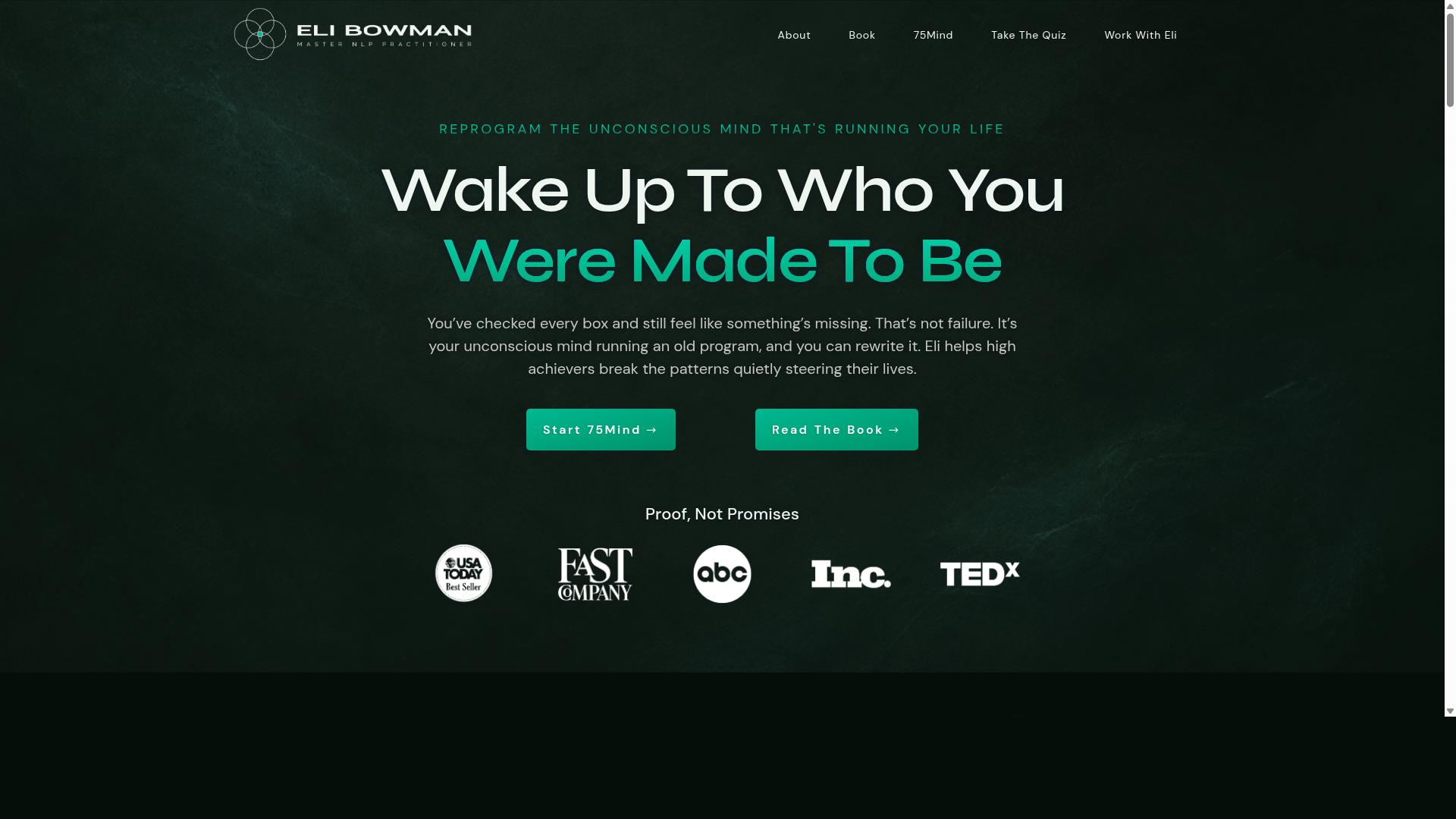
Mindset coaching is a structured process that helps you identify and rewire the unconscious beliefs driving your behavior, and Eli Bowman's approach blends NLP with neuroscience to target those hidden patterns.
It sits in a distinct lane from other forms of support. Life coaching tends to focus on goals, planning, and accountability. Therapy often addresses clinical concerns such as anxiety, trauma, or depression.
Mindset coaching works on the layer beneath both: the belief systems and thought patterns that quietly shape how you act, react, and decide. It is built for capable people who are still stuck.
Eli Bowman applies these principles through a neuroscience-based lens, with a specific focus on subconscious reprogramming for high achievers.
Defining Mindset Coaching and the Unconscious Mind
At its core, mindset coaching operates on the premise that most of your daily actions are driven by unconscious programming rather than conscious choice.
That programming shows up as automatic reactions, ingrained habits, and emotional responses you did not deliberately choose. Left unexamined, it can run the show.
Three terms come up constantly in this work:
- Limiting beliefs: conclusions like "I am not the kind of person who succeeds at this" that feel like facts but are learned assumptions.
- Self-sabotage: behavior that undermines your own stated goals, often right when success is closest.
- Cognitive distortions: predictable errors in thinking, such as catastrophizing or all-or-nothing reasoning, that distort how you read a situation.
Mindset coaching uses tools like metacognition, or thinking about your thinking, and deliberate self-awareness to bring these patterns into conscious view. Mindfulness and structured reflection support the same goal: noticing the pattern before it runs.
The biological basis for change is neuroplasticity, the brain's ability to rewire itself through repeated experience and attention. Neural pathways strengthen with use and weaken without it, which is why consistent practice matters more than a single insight.
Consider a high achiever who procrastinates on high-stakes projects. On the surface it looks like poor time management. Underneath, it may be an unconscious fear of failure: if the work is never finished, it can never be judged. Coaching surfaces that belief, tests it, and replaces it with an enableing belief that supports action instead of avoiding it.
Who Eli Bowman Is: Speaker, Author, and Master NLP Practitioner
Eli Bowman is a mindset keynote speaker, author, and Master NLP Practitioner certified by the American Board of Neuro-Linguistic Programming.
He is also a TEDx speaker and a USA Today bestselling author. His work centers on reprogramming the unconscious mind to help high achievers break patterns that quietly steer their lives.
His path into this field was not academic first. He spent nearly 20 years building companies, some of which failed before successful ones followed. Learning how the unconscious mind works changed his approach, and that discovery became the foundation of his teaching.
He is the author of The Program, a book that reflects his emphasis on a neuroscience-based approach to behavioral change. Rather than treating motivation as the missing piece, his philosophy targets the invisible patterns underneath it.
Beyond speaking, he offers coaching, speaking engagements, retreats, and a 75-day mindset program called 75Mind. The brand is operated by Movement Maker LLC.
His audience is specific: high achievers who have already proven they can execute, yet keep hitting the same internal wall. In his framing, the problem is rarely effort. It is the belief system directing where that effort goes.
That is why his work leans on cognitive reframing, identity shift, and habit formation rather than generic goal setting. The aim is durable personal transformation, not a short burst of motivation.
How Mindset Coaching Works, Step by Step
Mindset coaching typically follows a structured arc: first uncovering the unconscious patterns that drive behavior, then systematically reprogramming them using proven techniques.
While the exact steps vary by practitioner, most effective approaches move through four stages: assessment, pattern recognition, intervention, and integration. The two core phases remain constant. Identification comes first, then reprogramming.
Eli Bowman, a USA Today bestselling author, TEDx speaker, and Master NLP Practitioner certified by the American Board of Neuro-Linguistic Programming, frames this work around a striking premise: 90-95% of everything you do, feel, and decide is controlled by the unconscious mind. That single idea explains why willpower alone rarely creates lasting change.
The detailed methods behind each phase follow below.
Identifying the Unconscious Patterns That Quietly Steer Your Life
The first step in any mindset coaching engagement is making the invisible visible, mapping the unconscious beliefs and emotional triggers that operate beneath your conscious awareness.
Coaches draw on several identification methods, and most engagements combine a few of them:
- Guided self-inquiry, where open questions surface memories and reactions you rarely examine
- Journaling prompts that reveal repeated emotional themes over days or weeks
- Behavioral pattern tracking, logging moments of procrastination, avoidance, or overreaction
- Psychometric-style assessments that map tendencies across situations
From this data, recurring themes emerge. Common ones include fear of success, imposter syndrome, a scarcity mindset, and a harsh inner critic. A client who consistently undercharges for their services, for example, may trace that habit to a deep-seated belief: I'm not worthy of more.
Eli Bowman's site includes a free 2-minute quiz to uncover unconscious programming, a simple entry point for anyone curious about their own patterns before committing to deeper work.
One point deserves emphasis. Identification is not about blame. It is about gathering data. You cannot reprogram a belief you have never noticed, and self-awareness, not self-judgment, is what makes the next phase possible. This is metacognition in practice: observing your own thought patterns as an outside witness rather than being run by them.
Reprogramming Techniques: NLP and a Neuroscience-Based Method
Once unconscious patterns are identified, the reprogramming phase uses techniques like NLP anchoring, cognitive reframing, and visualization to build new neural pathways.
Several specific tools do the heavy lifting. NLP submodalities work by changing the intensity of your internal representations, for instance shrinking a frightening mental image or softening a critical inner voice. Timeline therapy helps clients revisit how a belief formed and release its emotional charge. Pattern interrupts break automatic reactions in the moment, creating space for a different response.
Cognitive reframing then swaps a limiting belief for an enableing one. A client who says I always freeze in high-pressure situations might reframe that as I have practiced staying calm and can access that calm on demand. The new statement is not wishful thinking. It is a claim the client earns through repetition.
That repetition matters because of neuroplasticity, the brain's capacity to rewire itself. Each time a new thought pattern is rehearsed with genuine emotional engagement, the associated neural pathways strengthen. Over time, the enableing belief becomes the default.
Accountability and action bias cement the change. Insight alone rarely survives contact with old habits, so coaches pair reprogramming with real-world assignments and consistent follow-through. This is where an identity shift takes hold, and where Eli Bowman's 75Mind program applies the same logic: it is mindset-first rather than fitness-first, built on NLP principles, and requires completion of all eight daily habits or a restart from Day 1, with zero negotiation.
Combined with emotional regulation skills and steady practice, these techniques turn subconscious reprogramming from theory into durable personal transformation.
What Makes Eli Bowman's Approach Stand Out
Eli Bowman's approach stands out because it combines the precision of NLP with a neuroscience-based framework, focusing on root-cause reprogramming rather than surface-level motivation. Where many coaching relationships revolve around weekly check-ins and encouragement, his work targets the machinery underneath behavior: the beliefs, thought patterns, and unconscious scripts that quietly steer decisions.
The starting premise is simple to state and hard to argue with. Eli notes that 90-95% of everything you do, feel, and decide is controlled by the unconscious mind. If that figure is even roughly right, then willpower and goal-setting alone are working on a tiny slice of the problem. His method treats the other 90-95% as the real territory to cover.
That is the core contrast with generic life coaching. Traditional coaching often relies on accountability: someone checks in, you report progress, and momentum builds through external pressure. Accountability has value, but it rarely touches a limiting belief that says you are not the kind of person who succeeds at this. Eli does not just help you set better goals. He helps you rewire the beliefs that determine whether you achieve them.
Several elements define how this plays out in practice:
- Neuroscience-based explanation: every technique comes with a reason it works, so clients understand the "why" instead of following instructions on faith.
- Unconscious reprogramming: the focus sits on subconscious patterns, not just conscious goal lists.
- Root-cause orientation: surface habits get addressed after the belief driving them is found.
- Credentialed expertise: Eli is a Master NLP Practitioner certified by the American Board of Neuro-Linguistic Programming.
- Track record: he is also a USA Today bestselling author and a TEDx speaker.
- Audience fit: his work is tailored to high achievers who have already proven they can execute and still feel stuck.
Understanding the mechanism matters because it changes how a client relates to the work. When someone learns that neuroplasticity allows neural pathways to be reshaped through repeated, directed attention, a setback stops looking like proof of a fixed mindset. It becomes feedback about which pathway is still dominant.
This is where cognitive reframing, emotional regulation, and metacognition enter the picture. Clients learn to observe their own thinking, catch cognitive distortions and negative self-talk as they arise, and interrupt self-sabotage before it compounds. That kind of self-awareness is a skill, not a personality trait, and it can be trained.
The high-achiever focus is deliberate. People who already run businesses, lead teams, or perform at a high level rarely need help with motivation or action bias. They need help locating the identity-level belief that keeps generating the same ceiling. An identity shift at that depth is what makes personal transformation durable rather than a temporary spike in effort.
For anyone weighing mindset coaching against executive coaching or standard life coaching, the distinction is worth holding onto. Accountability keeps you moving. Belief systems determine where you can move to. Eli Bowman's method is built for the second question, and that is what makes it stand apart.
Ways to Work With Eli Bowman: Coaching, Speaking, Retreats, and 75Mind
Eli Bowman offers four primary ways to engage: one-on-one coaching, keynote speaking, live retreats, and his self-guided program, 75Mind. Each path serves a different level of support, from fully personalized guidance to a structured digital roadmap you follow on your own schedule.
What ties them together is a single focus: subconscious reprogramming. Every format is built to help you surface unconscious patterns, examine the belief systems driving them, and replace what no longer serves you. The difference is simply how much direct access to Eli you want along the way.
All four services are available globally online, so location is not a barrier. Coaching and speaking are custom-quoted based on your needs, while 75Mind has a fixed price. Below is a closer look at each option.
- One-on-one coaching for personalized insight into unconscious patterns
- Keynote speaking for events and audiences
- Retreats and live experiences for immersive group work
- 75Mind, a 75-day self-guided mindset program
One-on-one coaching is the most personalized route. Sessions are designed to give you insight into the unconscious patterns shaping your decisions, reactions, and results. This format suits high achievers who have already tried surface-level fixes and want deep, durable change.
Rather than handing out generic advice, this work targets the root: the limiting beliefs and automatic thought patterns that quietly drive self-sabotage. Expect a collaborative process built on self-awareness and honest reflection. Pricing is custom-quoted, since scope and frequency vary by client.
Keynote speaking brings the same ideas to a live audience. Eli tailors talks to the event, drawing on his TEDx experience and neuroscience-based insights. The result is a presentation grounded in performance psychology rather than abstract motivation.
For organizations, conferences, and teams, a keynote can introduce mindset coaching concepts at scale. Attendees leave with a clearer understanding of how thought patterns form and how cognitive reframing can shift them. Speaking engagements are custom-quoted based on the event.
Retreats and live experiences offer the deepest immersion. These are intensive, in-person style formats where participants do focused work on identity shift and behavioral change, away from daily distractions.
Immersive settings tend to accelerate breakthroughs because they combine concentrated time, guided reflection, and shared accountability. If you want more than a weekly session, a retreat compresses months of progress into a short window. Like coaching and speaking, retreats are custom-quoted.
75Mind is the most accessible entry point at a fixed price of $75 with instant access. It is a 75-day mindset program built around eight daily habits: track sleep, a morning gratitude practice, meditation or prayer, 30 minutes of intentional physical movement, at least 30 minutes of focused reading, daily social accountability, drinking 100 oz of water, and an evening journal entry.
The structure is deliberate. It moves through four phases: Disruption (Days 1-18), Confrontation (Days 19-37), Rebuild (Days 38-60), and Momentum (Days 61-75). This arc mirrors how real change unfolds, from breaking old routines to locking in new ones.
Included with the program are a participant guide PDF, a phase-by-phase roadmap, daily reflection prompts, rules and standards and expectations, and community access. It is fully self-paced, which makes it a strong fit for anyone who wants structure without scheduled sessions.
Eli's USA Today bestselling book, The Program, covers reprogramming the unconscious mind and pairs naturally with the 75Mind approach. Readers who want the underlying framework before committing to a format often start there.
Which option fits you? If you want personal attention and are ready to invest, one-on-one coaching delivers the most tailored support. If you are organizing an event, a keynote spreads the message to your whole audience.
For total immersion, a retreat concentrates the work into an intensive stretch. And if you prefer to move at your own pace, 75Mind gives you a complete daily system for a flat $75. Many people combine formats over time, starting with the digital program and adding coaching later.
The bottom line: Eli Bowman is a legitimate, established voice in mindset coaching, backed by a bestselling book, TEDx speaking experience, and a structured program with clearly defined phases and habits. Whether you choose private coaching, a keynote, a retreat, or 75Mind, you are working with a proven framework for personal transformation, available to you anywhere in the world.
Pricing: What It Costs to Get Started
The most accessible entry point is 75Mind, a one-time purchase of $75 that provides instant access to Eli Bowman's self-guided reprogramming program. There is no subscription, no recurring billing, and no upsell required to begin the work.
That single payment unlocks the full program the moment it is made. For anyone curious about how subconscious reprogramming and belief systems work in practice, 75Mind removes the usual financial barrier that keeps people on the sidelines of personal transformation.
It also serves a practical purpose. Rather than committing to a larger engagement before knowing whether Eli's methodology resonates, readers can experience the approach firsthand at a low-risk price point.
For one-on-one coaching, keynote speaking, and retreats, pricing is not publicly listed. These services are custom-quoted based on scope and duration, since each engagement is shaped around the individual client, audience, or organization.
A keynote for a large corporate event and a multi-month executive coaching arrangement involve very different commitments of time and preparation. That variability is why a single published rate would not reflect what most clients actually need.
The simplest path is to use the contact form to inquire about custom pricing. Sharing a few details about the goal, the timeline, and the setting helps produce an accurate quote rather than a rough guess.
Viewed as a whole, the structure makes sense. 75Mind acts as the front door, an affordable way to test the waters of mindset coaching and see how cognitive reframing and identity shift principles apply to real life.
From there, clients who want deeper accountability and personalized guidance can step into coaching, speaking, or retreat experiences tailored to their situation. The low-cost entry does not cheapen the work. It widens access to it.
For anyone weighing whether mindset coaching is worth exploring, starting with a $75 one-time program is a sensible, low-commitment first step.
Trust Signals: Credentials, Bestselling Author Status, and Track Record
Eli Bowman's credibility rests on verifiable credentials: USA Today bestselling author, TEDx speaker, and Master NLP Practitioner certified by the American Board of Neuro-Linguistic Programming. Each of these signals points to a different kind of proof, from communication skill to peer recognition to formal training. Together they give prospective clients concrete reasons to take his mindset coaching work seriously.
Below is a breakdown of what each credential actually demonstrates, and why it matters when you are deciding whether to trust someone with your personal transformation.
USA Today bestselling author. Hitting a national bestseller list is not a vanity milestone. It requires a book that resonates with a wide audience, which means the author can take complex ideas and make them clear, engaging, and useful. For a mindset coach, that skill transfers directly to sessions, courses, and speaking engagements. If a coach can hold a reader's attention across an entire book, they can likely hold a client's attention through the harder work of examining limiting beliefs and thought patterns.
TEDx speaker. TEDx stages are selective. Speakers are chosen because they have an idea worth spreading and the ability to deliver it in a compressed, high-stakes format. For Bowman, this signals recognition as a thought leader in his space. It also suggests he can communicate about mindset coaching, behavioral change, and cognitive reframing to audiences beyond one-on-one clients, which is a useful indicator of how clearly he thinks and speaks.
Master NLP Practitioner certification. This credential comes from the American Board of Neuro-Linguistic Programming, a specific certifying body. It shows rigorous training in a defined methodology rather than a self-declared title. NLP techniques often overlap with subconscious reprogramming, emotional regulation, and self-awareness work, all of which are central to the kind of coaching Bowman describes. Certification does not guarantee a perfect fit for every client, but it does confirm a structured foundation.
Nearly 20 years building companies. Bowman shares that he spent almost two decades building businesses, some of which failed before the successful ones. That track record matters because it means his coaching is grounded in lived experience, not just theory. Failure and recovery tend to sharpen resilience, action bias, and habit formation in ways that classroom study alone cannot replicate. He also says that learning how the unconscious mind works changed his approach, which connects his business background directly to the mindset methods he now teaches.
Global reach. Bowman serves clients worldwide online, which means geography is not a barrier to working with him. For readers considering executive coaching or life coaching, remote delivery expands access and often makes scheduling more flexible.
A note on testimonials. The testimonials currently shown on the 75Mind page are placeholder text (Lorem ipsum), not real client quotes. That is worth knowing so you do not mistake them for social proof. Until genuine testimonials are published, the strongest evidence of credibility is the combination of credentials above, plus your own direct experience in a session or conversation with Bowman.
The verdict on trust signals. Taken together, a USA Today bestselling book, a TEDx talk, a Master NLP Practitioner certification, nearly 20 years of business building, and a global client base form a credible, checkable profile. None of these signals is a guarantee of results, and no honest coach would claim otherwise. But they are far more than marketing language, and they support a confident conclusion: Eli Bowman is a legitimate, credentialed mindset coach worth evaluating seriously.
Who Mindset Coaching Helps - and Who Eli Bowman Works With
Eli Bowman works primarily with high achievers who feel something is missing despite checking every box-people who struggle with self-sabotage, income ceilings, or a vague restlessness. They often look successful from the outside. Inside, the story is different.
This is the paradox of external success without internal alignment. A person can hit every milestone, earn the promotion, close the deal, and still wake up wondering why none of it feels like enough. That gap between achievement and fulfillment is exactly where mindset coaching does its most important work.
Mindset coaching is not about adding more skills or strategies. It is about examining the belief systems and thought patterns running beneath the surface, the ones shaping decisions, reactions, and results without ever being questioned.
Eli Bowman's client profile is specific. These are not people starting from zero. They are people who have already proven they can execute, and who now sense that the next level requires something different: inner work, not another tactic.
Common pain points among this group include:
- Self-sabotage that shows up right before or right after a breakthrough
- Career or income plateaus that persist no matter how hard they push
- Chronic restlessness, a sense that something is off even when nothing is wrong
- Lack of clarity on purpose, with no clear answer to what they actually want
- An inner critic that stays loud no matter how much external validation arrives
These patterns rarely respond to more effort. They respond to self-awareness, metacognition, and a willingness to look at the beliefs generating the behavior in the first place. A scarcity mindset, for example, can drive someone to chase achievement endlessly while never feeling secure. An identity shaped by old limitations can quietly cap what a person allows themselves to earn or pursue.
Eli Bowman also works with organizations looking for speakers, retreats, or ways to bring this work to their teams. The same principles that help an individual apply to groups navigating performance, resilience, and behavioral change.
Who is not a good fit matters just as much. Mindset coaching is not clinical therapy, and it does not replace mental health treatment. Someone in acute crisis needs a licensed professional, not a coach.
It is also not for anyone seeking a quick fix. There is no hack, no single insight, and no weekend that permanently rewires decades of conditioning. Neuroplasticity is real, but it works through repetition, honesty, and time.
The people who benefit most share a common trait: they are ready to do deep, internal work. They want personal transformation, not just better performance. They are willing to question their own narrative, sit with discomfort, and practice new ways of thinking until those pathways become default.
If that describes you, mindset coaching is likely a strong fit. If you want someone to hand you a formula and skip the introspection, it is not. Eli Bowman's approach is built for the former: people who have already achieved and are now ready to align who they are with what they do.
Final Verdict: Is Eli Bowman's Mindset Coaching Worth It?
If you're a high achiever who has tried willpower and goal-setting without lasting change, Eli Bowman's mindset coaching offers a root-cause approach that may be worth the investment. The work targets the belief systems and thought patterns underneath self-sabotage rather than the surface behaviors alone.
That distinction matters. Willpower fades, but subconscious reprogramming aims to change the operating system itself. When limiting beliefs lose their grip, new habits and goals stop feeling like constant uphill fights.
For readers who recognize themselves in the target audience profile, Eli's credentials and neuroscience-based method provide a credible path to personal transformation. The approach combines cognitive reframing, metacognition, and emotional regulation into a structured process rather than vague motivation.
Commitment is the honest caveat. Coaching is an investment of both money and effort, and results depend on how consistently you apply the tools between sessions. Anyone expecting passive change will be disappointed. Anyone ready to do the inner work has a genuine shot at an identity shift that outlasts the program itself.
If you want to test the approach before committing to deeper work, 75Mind at $75 is the natural starting point. From there, you can step up to one-on-one coaching or retreats if the fit feels right. That progression lets you experience the method firsthand before scaling your investment.
To explore coaching or speaking, the contact form on the site is the place to start. Following Eli on Instagram, Facebook, YouTube, and LinkedIn is a low-pressure way to absorb insights on resilience, growth mindset, and belief systems before you decide anything.
The verdict: for high achievers stuck in cycles of negative self-talk and stalled goal achievement, Eli Bowman's mindset coaching is a legitimate, well-structured option worth serious consideration. Start small, stay committed, and let the results speak for themselves.
Frequently Asked Questions
What exactly is mindset coaching, and how is Eli Bowman's approach different?
Mindset coaching helps you identify and rewire the unconscious patterns that quietly drive your behavior, decisions, and results. Eli Bowman's approach is specifically neuroscience-based, built on the premise that 90-95% of your behavior runs below conscious awareness. As a Master NLP Practitioner certified by the American Board of Neuro-Linguistic Programming, he focuses on reprogramming the unconscious mind rather than just offering surface-level motivation or advice.
Who is mindset coaching with Eli Bowman actually for?
It's designed for high achievers who feel something is missing despite checking every box-people dealing with self-sabotage, career or income ceilings, vague restlessness, or a lack of clarity on their purpose. Eli also works with organizations. If you're succeeding on paper but stuck underneath, that's exactly the gap his work targets.
What does working with Eli Bowman look like in practice?
Eli offers one-on-one personal coaching sessions for personalized insight into your unconscious patterns, keynote speaking for events, and retreats or live experiences. Because his work is global and delivered online, you can access coaching and digital resources remotely from anywhere. For specifics on format and fit, the best first step is reaching out through the contact form on his site.
How much does coaching or speaking with Eli Bowman cost?
Coaching and speaking engagements are typically custom-quoted based on your goals and scope, so there's no publicly listed price for those. The one clearly priced offer is 75Mind, a one-time $75 purchase with instant access. For coaching or event rates, submit an inquiry through the contact form.
What is 75Mind, and is it a good place to start?
75Mind is Eli's digital offering, available as a one-time $75 purchase with instant access. It's a low-commitment way to begin engaging with the same unconscious-pattern work he does in coaching. If you're curious but not ready for one-on-one sessions, it's a practical entry point.
What are Eli Bowman's credentials?
Eli is a TEDx speaker, a USA Today bestselling author of the book The Program, and a Master NLP Practitioner certified by the American Board of Neuro-Linguistic Programming. His work centers on reprogramming the unconscious mind to help high achievers break patterns that quietly steer their lives. You can also take his free 2-minute quiz to uncover your own unconscious programming.
Recommended Resources:

 LINKEDIN
 BEHANCE
 GITHUB